
Baby Development
Your four-month-old is staring at your dinner like it personally betrayed her, and the grandmothers are chanting ‘just a little rice cereal’. Or your six-month-old seems utterly uninterested and you’re wondering if you’ve missed the window. Starting solids is one of those milestones where everyone’s confident and nobody agrees — so let’s go by what actually matters: readiness, not dates.
The short answer
Start around six months, when your baby shows all three readiness signs: sitting with little support and steady head control, the ability to pick up food and get it to their mouth, and losing the tongue-thrust reflex that pushes food straight back out. Watching you eat with interest is a lovely bonus sign, not a requirement.
Why six months, and why the signs beat the date
For the first six months, milk — breast or formula — covers everything a baby needs, and their gut, kidneys and motor skills aren’t ready for more. Around six months, iron stores from birth start running low, chewing skills emerge, and the digestive system matures. That’s why the guidance lands on ‘around six months’.
But babies don’t read calendars, so the readiness signs are the real green light. A baby who can’t sit steadily and can’t move food to the back of the tongue isn’t ready at six months plus a day; a baby showing all three signs at five and a half months probably is. The signs exist precisely so you can read your own baby.
The part that often gets missed
The concept that makes starting solids calm instead of stressful: until one, food is for fun and learning, not for calories. Milk still does the nutritional heavy lifting for months, which means the pressure’s off — you’re teaching eating as a skill, not delivering a quota of nutrients. Messy, slow, mostly-wasted meals are the curriculum working as designed.
What you can actually do
1. Check the three readiness signs
The three signs, checked honestly: sits with minimal support holding their head steady; reaches for objects and brings them accurately to the mouth; and food offered on a spoon doesn’t get pushed straight out by the tongue. All three — green light. Missing any — wait a week or two and check again. There’s no prize for early.
The eager staring at your dinner is charming but not a readiness sign — babies stare at keys, phones and the dog with equal longing.
2. Start simple: one meal, midday
Pick one meal a day at a calm time — late morning works well, when the baby’s not tired or starving. Offer after or between milk feeds, in a highchair, you sitting with them. Start with smooth or very soft textures: vegetable and fruit purées or very soft finger-sized sticks of well-cooked veg, one new food at a time, a few days apart at first.
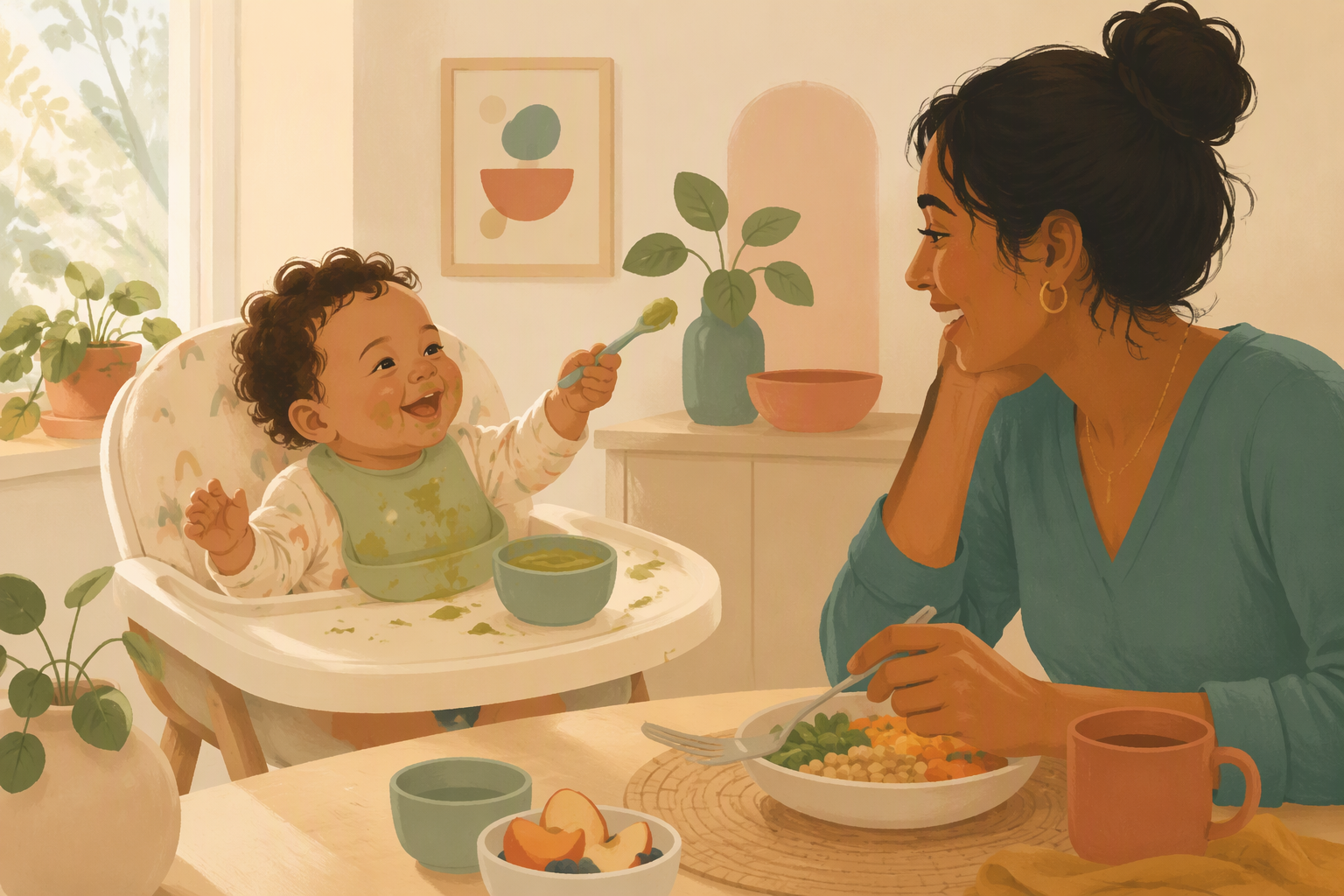
Expect the first weeks to be comedy: two spoons in, most of it on the bib, the face of pure betrayal. That’s not failure — that’s literally what learning looks like.
3. Offer iron-rich foods early
From the start, include iron: puréed meat or lentils, iron-fortified baby cereal, eggs well-cooked, nut butters thinned smooth. Iron is the nutrient milk starts running short of around six months, so it’s the first real job food has. Offer these early and often among the fruit-and-veg rotation.
Allergy guidance has changed: common allergens (egg, peanut thinned, wheat, dairy in cooking) are now introduced early and one at a time in the morning, rather than avoided — ask your child health nurse for your local guidance, especially with eczema or family allergies.
4. Know gagging from choking
Learn this before day one: gagging is loud, dramatic, red-faced and productive — it’s the baby’s safety reflex moving food forward, and it looks terrifying while being protective. Choking is silent or weak-coughed, with struggle and colour change — that’s the emergency. Every parent should watch a five-minute infant choking first-aid video before starting solids; it converts fear into competence.
Never leave a baby alone with food, keep them sitting upright, and skip the hard, round, coin-shaped foods — whole grapes, nuts, raw carrot coins. Soft, graspable, supervised: the three rules that keep meals safe.
When to check with your doctor or midwife
- A baby showing no readiness signs by seven months — mention it at the next check
- Food consistently pushed out by the tongue past seven months
- Any allergic reaction — hives, swelling, vomiting after a new food; face or tongue swelling or breathing difficulty is an emergency
- Coughing fits with colour change or silence — choking: act immediately and call emergency services
Where to start
If the three signs are there: tomorrow, late morning, one spoon of something soft and iron-rich, you sitting opposite with your own lunch. Keep it five minutes, keep it cheerful, and let the bib take the casualties.
Starting solids is a slow, hilarious, gloriously messy apprenticeship — not a nutrition deadline. Follow the signs, keep milk as the main event for now, and let your baby learn that food is fun. The eater you’re building matters more than the grams you’re counting.
Until one, food is for learning, milk is for growing. The pressure’s off — enjoy the mess.
Keep reading
Baby Not Rolling Yet? When to Ask About Development
Every other baby is rolling. Yours isn’t. Here’s when it’s normal variation and when it’s a conversation.
Toddler Won’t Listen? 5 Changes Worth Trying
You say it, they ignore it — how to actually get through to a toddler without shouting.
How to Prepare Your Toddler for a New Baby
A sibling is coming — how to help your firstborn meet the change without the heartbreak.
I hope this helped, even a little. Everything I write here comes from raising my three and from the planners and checklists I built because I needed them myself. If you take one thing from this page, let it be this: you are doing better than you think.
— Rahila x
Mum of three, obsessive list-maker, and the person behind Women Life Reset
Women Life Reset guides are general information, not medical advice. Always check your own situation with your doctor, midwife or health visitor.