
Baby Development
Your friend’s baby is crawling at seven months; yours is eight months and happily immobile. The milestone chart says ‘should be’, your heart says ‘is something wrong?’ If milestone-watching has become your background anxiety, let me reframe the whole thing: development is a range, not a race — and what matters isn’t when a skill arrives, but that skills keep arriving.
The short answer
The big-picture guide: social smiling around 6–8 weeks, steady head control by 4 months, rolling around 4–6, sitting by 6–8, babbling through the second half, crawling or shuffling 6–10, pulling to stand 9–12, first steps 9–15. Ranges are wide. Watch the direction of travel and the red flags, not the calendar.
Why milestone charts cause so much worry
Charts show averages, but babies aren’t average — they’re distributed. A skill ‘at six months’ might normally appear anywhere from four to eight. First babies, boys, girls, prem babies (count from due date, not birth date) — all move the window. The chart describes the middle of a wide road, and parents read it as a cliff edge.
What clinicians actually watch isn’t the schedule — it’s the pattern: steady progress, new skills arriving, no losses, and engagement with people. A baby a month ‘behind’ on sitting who’s smiling, babbling and reaching is on their own perfectly good road.
The part that often gets missed
The question that replaces anxiety: ‘Is my baby learning new things?’ Not ‘are they on time’ — are they moving forward? A baby who adds a sound, a reach, a roll, a new way of playing week by week is developing. The pace varies; the direction is the signal. One of mine crawled late and walked early; the chart had opinions, the baby had a plan.
What you can actually do
1. Watch direction, not dates
Keep a loose note of new skills as they appear — first real smile, first roll, first ‘baba’ — dated roughly. A list that grows every week or two is the pattern of healthy development, and it’s far more informative than comparing today’s baby to a chart. It’s also a gorgeous keepsake.
If the list stalls for a couple of months or skills disappear, that’s the data your child health nurse wants. Otherwise, let the dates be rough and the direction be the story.
2. Know the few milestones that matter most
A handful of milestones carry extra weight because they unlock others: head control (feeds everything physical), reaching and grasping (hands meeting the world), babbling and responding to sounds (language’s foundation), and social smiling plus eye contact (connection). Protect time for those through floor play and face time, and the rest tends to cascade.
Notice none of these require equipment. The developmental toolkit is floor, face, voice, and something to reach for.
3. Play is the whole curriculum
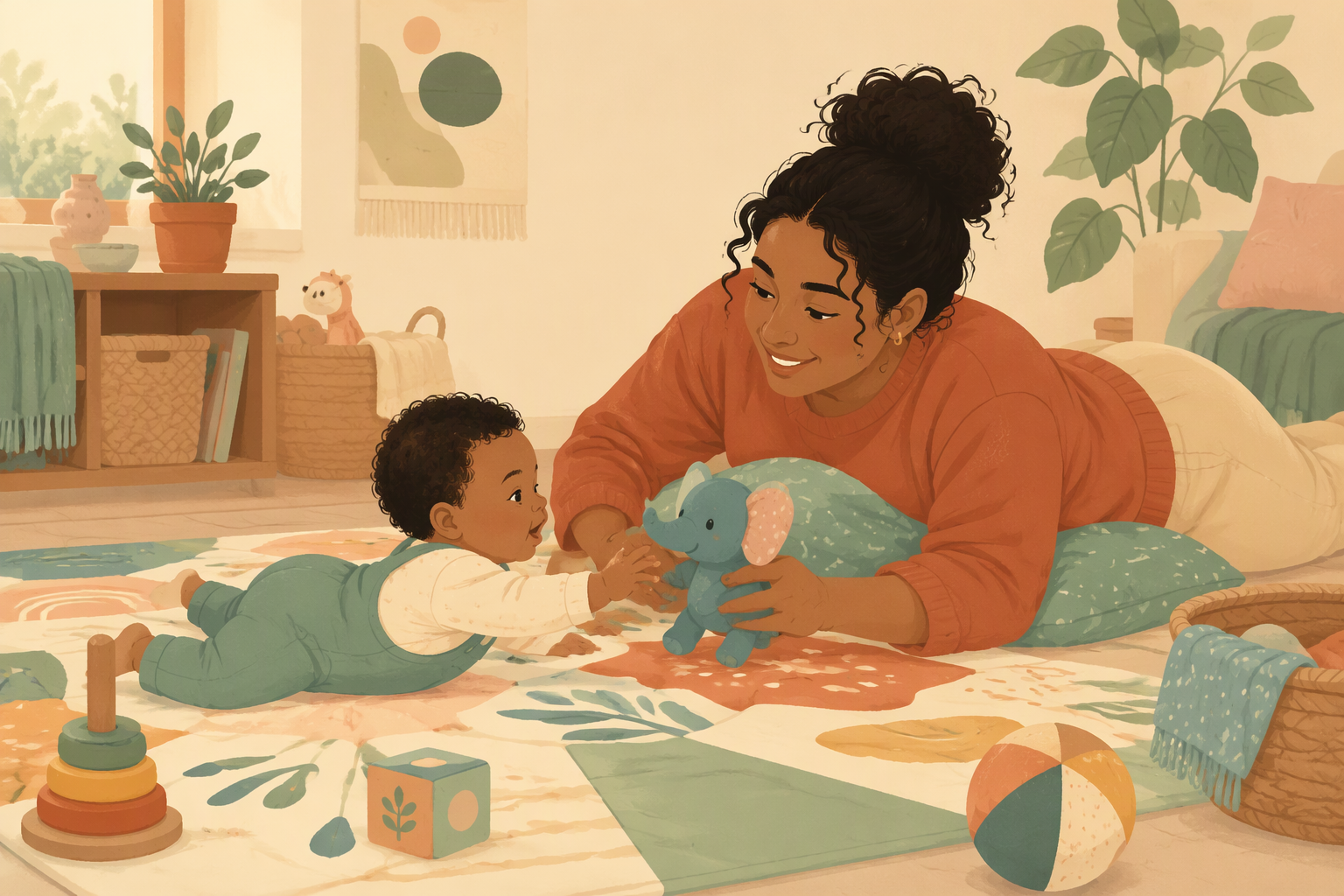
Babies develop through play, not programs: tummy-down floor time builds the physical chain (head, roll, sit, crawl), talking through your day builds language (‘now we’re washing bottles’), and simple games — peekaboo, rattles to track, objects to mouth safely — build thinking. Fifteen minutes of down-on-the-floor play a few times a day is the entire curriculum.
The most developmental toy ever made is your face narrating ordinary life. Everything else is a bonus.
4. Use your checks, properly
Your scheduled child-health checks are the safety net — attend them, and bring your notes plus your worries. ‘He’s not rolling and here’s what he is doing’ is a ten-second conversation that either reassures you or starts early support, and early support is where the wins are.
Between checks, your health visitor or GP is a phone call away, and ‘probably nothing’ calls are their bread and butter. Never save a worry for a milestone appointment months away.
When to check with your doctor or midwife
- Loss of any skill the baby previously had — always call within the week
- No social smiling by 3 months, no steady head control by 4 months
- Not sitting with support by 9 months, no babbling by 12 months
- Little eye contact, or not responding to sounds or their name
- Strong one-sidedness — always using one hand, dragging one side
Where to start
Today, start the skills list on your phone: three things your baby does now that they didn’t do a month ago. That growing list is your real milestone chart — and future worries will be answered by looking at it.
Your baby is writing their own development story at their own pace, and the plot that matters is forward motion, not page numbers. Watch the direction, play on the floor, talk through your days, and let the wide ranges be wide. The chart measures averages; you’re raising an individual.
Development is a range, not a race. Watch the direction of travel, not the calendar.
Keep reading
When Can Babies Start Solid Foods? Signs of Readiness
Around six months — but the calendar matters less than these three readiness signs.
Baby Not Rolling Yet? When to Ask About Development
Every other baby is rolling. Yours isn’t. Here’s when it’s normal variation and when it’s a conversation.
Toddler Won’t Listen? 5 Changes Worth Trying
You say it, they ignore it — how to actually get through to a toddler without shouting.
I hope this helped, even a little. Everything I write here comes from raising my three and from the planners and checklists I built because I needed them myself. If you take one thing from this page, let it be this: you are doing better than you think.
— Rahila x
Mum of three, obsessive list-maker, and the person behind Women Life Reset
Women Life Reset guides are general information, not medical advice. Always check your own situation with your doctor, midwife or health visitor.