
Pregnancy Q&A: Everything You Were Afraid to Google at 3 a.m.
Twenty-five questions moms actually ask — answered plainly, without judgment or jargon. For anything about your pregnancy, your own provider always gets the final word.
01First Trimester
Take a breath — you have time. Three things matter this week: start (or keep taking) a prenatal vitamin with at least 400 mcg of folic acid, call your provider to book a first appointment (usually around week 8), and go easy on yourself with rest and simple food. Everything else can wait until week two. Our first trimester checklist walks the whole stretch week by week.
Whenever you want. Many families wait until after the first trimester because miscarriage risk drops sharply after 12 weeks, but there is no rule. Tell the people you would lean on if things went wrong, whenever it feels right. Your news, your timeline.
The real list is shorter than the internet suggests: high-mercury fish (shark, swordfish, king mackerel), raw or undercooked meat and eggs, unpasteurized dairy and juices, and deli meats unless heated until steaming. Alcohol is off the menu entirely. Anything else that has you worried is a question for your provider, not a forum.
Yes. Most guidelines agree that up to about 200 mg of caffeine a day — roughly one 12-ounce coffee — is considered safe in pregnancy. Just count the sneaky sources too: tea, chocolate, soda, and energy drinks all add to the daily total.
Eat small amounts often (an empty stomach makes nausea worse), keep plain crackers by the bed, and ask your provider about ginger and vitamin B6. Cold foods smell less than hot ones, which helps more than you would think. If you cannot keep liquids down for 24 hours or you are losing weight, call your provider — severe sickness (hyperemesis) is real and treatable.
Light spotting can be perfectly normal — implantation, a sensitive cervix, or no identifiable reason at all. But bleeding with pain, heavy bleeding, or anything that scares you deserves a same-day call to your provider. You will never regret calling; answering that call is literally their job.
02Second Trimester
First-time moms usually feel the first flutters between 18 and 22 weeks; second-timers often notice around 16. Early movement feels like bubbles, popcorn, or a fish swimming past — easy to mistake for digestion until one day it clearly is not.
It depends on your starting point — roughly 25 to 35 pounds for an average starting weight, less if you started higher, more if lower. Your provider tracks your curve at every visit, so let them own this one. Think ‘eating twice as well’ rather than ‘eating for two’ — pregnancy is not a diet season in either direction.
Round ligament pain (sharp twinges low on one side when you move quickly), backache, hip pain at night, and leg cramps are all common. A warm bath, a pregnancy pillow, and gentle stretching help. Severe pain, pain with bleeding, or a headache that will not quit are not on the normal list — call your provider.
For most pregnancies, yes — movement is genuinely good for you and the baby. Walking, swimming, prenatal yoga, and light strength work are favorites. Skip anything with a fall or collision risk, avoid long stretches flat on your back after mid-pregnancy, and run your routine past your provider once.
The second trimester is the sweet spot — you have energy again, and the 20-week scan usually answers the big questions. Start with the boring essentials (car seat, sleep space, diapers) before the cute stuff. Our nursery and budget planner maps what to splurge on, what to skip, and when to buy each thing.
For uncomplicated pregnancies, flying is generally fine until about 36 weeks domestically — airlines set their own cutoffs and international is often earlier. The second trimester is the classic babymoon window. Wear compression socks, walk the aisle every hour, drink plenty of water, and carry your prenatal records just in case.
03Third Trimester & Birth
Aim for packed by week 34 to 36 — early enough that a surprise does not catch you, late enough that you still have your chargers. Organize by person (you, baby, partner) and split everything into ‘pack ahead’ versus ‘grab on the way out’. Our hospital bag checklist does all of that thinking for you.
You need a birth preferences page, not a script. Labor is famously unscripted, but writing down your hopes — pain relief, environment, who cuts the cord, first-hour wishes — helps your team support you fast. One page, honest priorities, plan-B mindset. Our birth preferences template is exactly that page.
Contractions that come regularly, get stronger, and do not stop when you rest or hydrate. Waters breaking — a gush or a steady trickle. A bloody show. Time the contractions and follow your provider’s rule, often 5-1-1: every 5 minutes, lasting 1 minute, for 1 hour. When in doubt, call. Labor triage answers these calls all night, and you will not be the first.
On your side — the left is ideal for blood flow, but either side beats your back. A pillow between the knees and one under the bump changes everything. If you wake up on your back, do not panic; just roll to your side and drift off again.
From 28 weeks, learn your baby’s pattern — busy times, quiet times. If movement feels clearly reduced, drink something cold, lie on your left side, and count. Fewer than 10 movements in 2 hours — or simply a gut feeling that something is off — means call your provider or go in. Always. They would far rather check a healthy baby than have you wait at home worrying.
The fourth trimester deserves a plan too: freeze meals now, agree visitor rules before you are sleep-deprived, stock recovery supplies, and lower every household standard in writing. Our First 42 Days course and the freezer meal system exist for exactly this.
04Health & Feelings
The call-now list: heavy bleeding, severe headache or vision changes, sudden swelling of face or hands, regular contractions before 37 weeks, fever over 100.4°F (38°C), clearly reduced baby movement, leaking fluid, or pain that does not ease. Save your provider’s after-hours number in your phone tonight.
Yes — perinatal anxiety and depression affect roughly 1 in 5 moms, and pregnancy hormones plus a huge life change is a lot for anyone. Tell your provider honestly how you are feeling; treatment works, and asking for help is strong, not weak. If it feels dark or urgent, call or text Postpartum Support International at 1-800-944-4773 — they help during pregnancy too, not just after.
Unless your provider has said otherwise (placenta previa, risk of preterm labor, or broken waters), sex is safe throughout pregnancy — the baby is sealed away and completely unbothered. Expect to adjust positions as the bump grows, and expect desire to ebb and flow. Both are normal.
Mostly, no — they are largely genetic, and they are a mark of doing something extraordinary. Creams and oils soothe the itch and feel lovely, which is reason enough to use them, but no product reliably prevents them. Most fade dramatically in the year after birth.
05Planning & Practical
Start the conversation in the second trimester: learn your legal entitlements, your employer’s policy, and your state’s programs, then notify your employer with comfortable notice — 30 days is a common minimum, earlier is kinder. Get the agreed plan in writing. And when the return feels closer, our Back to Work, Mama course walks that transition step by step.
Around 28 to 32 weeks, ask your OB, friends, and local parent groups for names, then book a prenatal meet-and-greet — most practices offer them free. Ask about after-hours care, same-day sick visits, and their approach to feeding questions. Pick the one who makes you feel heard rather than rushed.
Less than the internet insists: a safe sleep space, a properly installed car seat, diapers, a handful of clothes, feeding supplies, and a thermometer. Everything else is convenience — and convenience is allowed, just buy in that order. The complete pregnancy organizer keeps the list, the appointments, and your questions for the doctor in one calm place.
Still carrying a question?
Send it to me through the contact page — a real person reads every note. Or take the 2-minute quiz and find out which season of mom-brain you are in.
Get the free First Trimester Checklist →
Packed the whole bag in one afternoon at 35 weeks — when my waters broke early I just grabbed it and went. It’s a plain checklist, nothing fancy, but it did its job when it mattered.
Popular on the blog




Fresh from the blog




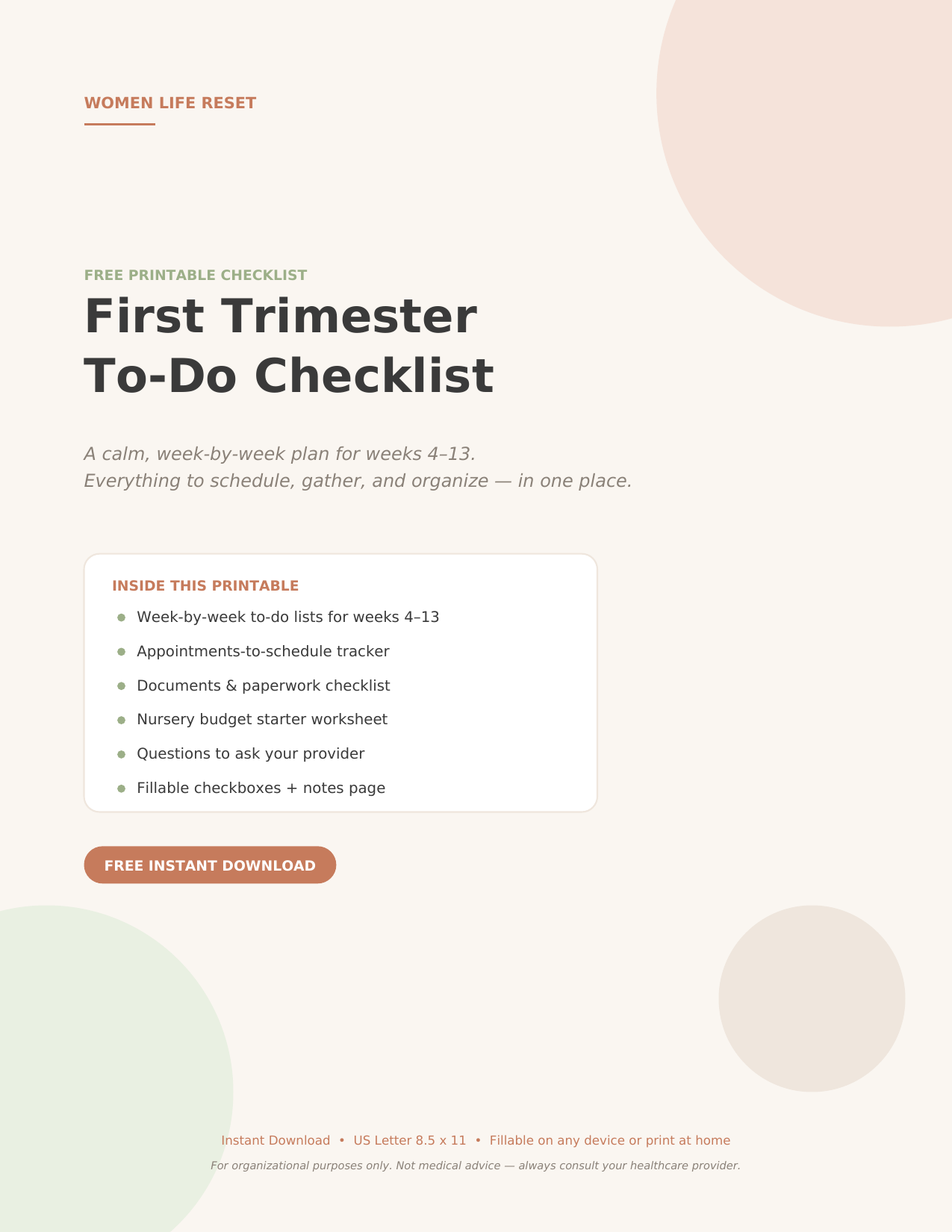
The First Trimester Checklist (free)
Weeks 1–13, organized: every appointment, every question worth asking, every “is this normal?” answered. Pop your email in and it’s yours — plus MOMCLUB15, 15% off everything in the store, always.
No spam, no pressure — unsubscribe anytime and keep the checklist. Only gentle notes from me, Rahila.