

Newborn’s First Weeks: Simple Trackers That Keep You Sane
There’s a moment in week one — usually around 4 a.m. — when a nurse, a partner, or your own brain asks: “When did the baby last eat?” And you genuinely do not know. Was it 40 minutes ago? Three hours? Is time real?
Sleep deprivation scrambles exactly the kind of memory that newborn life constantly demands. That’s what trackers are for. Not to optimize your baby, not to hit targets — simply to be an external brain that remembers feedings, sleep, and diaper counts when you can’t. And at the pediatrician’s office, they turn vague answers (“uhhh, pretty often?”) into useful information you can actually share.
Here’s what to track, how to keep it effortless, and when to let the whole system go.
In this article
The heart of it
- Track the core four: feeds, wet diapers, dirty diapers, sleep
- Paper or app — pick one and commit; splitting is where data dies
- A lazy-proof system lives where you feed, with one hand in mind
- Bring your logs to pediatric appointments — patterns answer questions fast
- Stop tracking when it stops serving you; it is a tool, not a sentence
Why Track At All? (The 30-Second Case)
- Your memory is offline. Sleep deprivation reliably erases short-term details. A log never forgets.
- Pediatricians ask data questions. “How many wet diapers yesterday?” “How long between feeds?” Having real notes makes appointments faster and more useful — and your pediatrician can interpret what’s normal or worth a closer look, which is their expertise, not yours.
- Patterns become visible. Babies who look random on day 4 often show clear rhythms by week 3 — but only on paper.
- Handoffs get easy. Partner, grandparent, or sitter can pick up mid-day without a 20-minute briefing. The log is the briefing.
The Core Four: What to Track
Keep it minimal. Four columns cover 95% of what anyone will ask:
| Column | What to jot | Why it matters |
|---|---|---|
| Feeding | Time started + duration or amount | The #1 pediatrician question in week one |
| Sleep | Start/end of longer stretches | Reveals emerging patterns; helps with handoffs |
| Diapers | Wet/dirty tally per day | A standard checkpoint at early appointments |
| Notes | One line max: mood, questions, oddities | Becomes your questions list for the pediatrician |
That fourth column is quietly the most valuable. “Spit up after every feed Tuesday — ask Dr. about it” written at 2 p.m. is a question you will absolutely not remember at Friday’s appointment. Any concern that pops up goes in the notes column, then goes to your pediatrician — interpretation is their job; your job is bringing them good notes.
Paper vs. App: Pick One and Commit
Paper trackers (a printable on the fridge or a notebook by the feeding chair):
– Pros: visible to everyone, no one-handed phone fumbling, doubles as a keepsake
– Cons: no automatic totals, can migrate around the house
App trackers:
– Pros: timers, totals, charts, syncs between parents’ phones
– Cons: screen time at 3 a.m., notification noise, the temptation to over-analyze charts
There’s no wrong answer — but there is a wrong approach, which is running both systems and reconciling them like a tiny accountant. One tracker, one location, everyone who feeds the baby uses it. (If you love journaling the bigger moments too, pair your log with a Pregnancy Journal-style keepsake so the memories live somewhere separate from the data.)
The Lazy-Proof Tracking System
Design for your most exhausted self:
- Station the tracker where feeds happen. Fridge clipboard or nightstand notebook — not across the room.
- Use shorthand. “8:15 L10 R8” beats sentences. Invent codes now, while you’re rested.
- Tally, don’t essay. Diaper counts are checkmarks. Notes are fragments. Perfectionism kills tracking systems by day 5.
- Assign the handoff ritual. When you tap out for a sleep shift, the last thing you do is update the log. Ten seconds, then bed.
- Don’t backfill guilt. Missed an entry? Skip it. A log that’s 80% complete answers every question that matters.
Free: the First Trimester Checklist
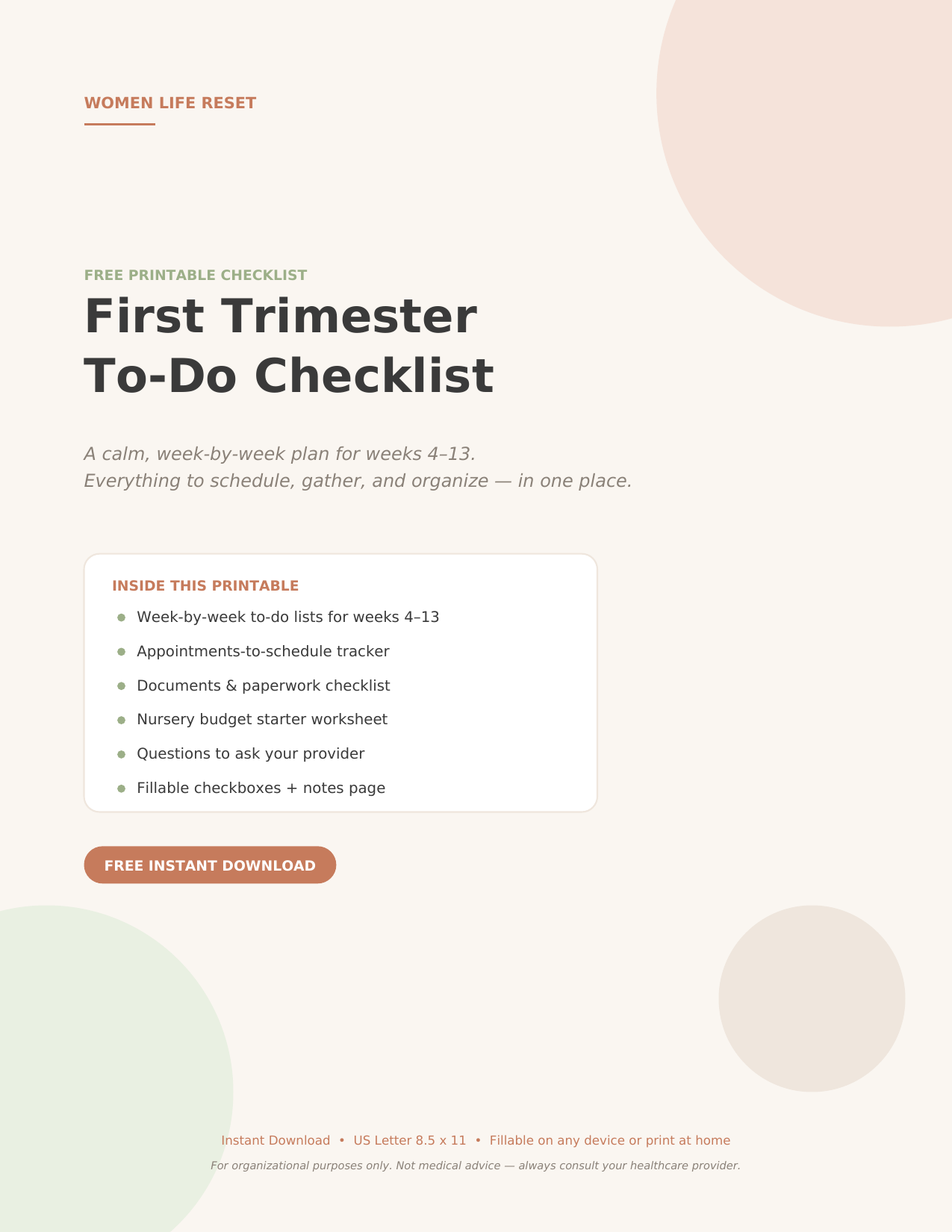
Weeks 1–13, gathered on four calm fillable pages — week-by-week to-dos, an appointment log, and room for your notes. It’s free.
What to Bring to Pediatric Appointments
Walk in with these and your first visits will feel almost organized:
- [ ] Your feeding/sleep/diaper log (the last 2–3 days minimum)
- [ ] Your running questions list from the notes column
- [ ] Anything the pediatrician’s office asked you to track specifically
- [ ] The baby’s records folder with paperwork from the hospital
Ask your pediatrician directly: “What would you like us to track, and for how long?” Most will tell you exactly what they care about — and just as importantly, when you can stop.
When to Stop Tracking
Here’s the part most tracker guides skip: tracking is a season, not a lifestyle. For most families, the intensive logging window is the first 2–6 weeks — until feeding feels established, patterns emerge, and the pediatrician gives the all-clear at early checkups. Signs you’re ready to retire the log:
- Your pediatrician says the data isn’t needed anymore
- You can answer “when did baby last eat?” without looking — because a rhythm exists
- The log feels like busywork instead of a safety net
When that day comes, celebrate: the trackers did their job. Keep the notebook somewhere safe — it’s a surprisingly emotional artifact of a blur you survived together. And if the first-weeks logistics felt like a lot, remember they pair with the household systems you (hopefully) set up in advance — meal trains, visitor plans, and help rosters are all in our postpartum organization guide.
A Sample Day in the Log
Here’s what lazy-proof tracking actually looks like — four columns, fragments only:
| Time | Feed | Sleep | Diaper/Notes |
|---|---|---|---|
| 6:40 | L12 R9 | — | wet |
| 9:15 | L10 | slept 7:20–9:00 | dirty |
| 12:30 | bottle 3oz | — | wet |
| 15:45 | L8 R11 | slept 13:10–15:20 | cluster-y afternoon? |
| 19:00 | R10 | — | wet — ask Dr. re: evening fussiness |
| 22:30 | L12 | down 23:00 | wet |
Total effort: about 60 seconds across the whole day. Total payoff at Friday’s appointment: enormous.
Notes for Twins (and Other Multiplied Chaos)
If you’re logging for two, add one initial per entry (“M: L10” / “J: bottle 2oz”) and keep one shared sheet rather than two notebooks. Track who did what — the classic twin-parent 3 a.m. question is “which one did we just feed?” and the log answers it without waking anyone.
Tracker FAQ
How long should a feed be / how much should baby eat?
That’s exactly the kind of question to bring to your pediatrician — with your log in hand. Your notes give them real data to interpret for your baby.
What if my partner refuses to track?
Shrink the ask: a single tally mark per diaper, one word per feed. Or accept a 70%-complete log — it’s still miles ahead of memory.
Do I need to track forever?
No — see the “When to Stop” section. Most families retire the log within the first month or two, on their pediatrician’s cue.
Can I use the log for my own recovery notes too?
Absolutely — a second notebook or a note on your phone for questions for your provider keeps both sets of records appointment-ready.
The Takeaway
One last reassurance: the tracker is a tool, not a test. There are no grades in newborn logistics, no perfect streaks to protect, and no prize for the most complete spreadsheet on the ward. Track four things, in one place, with shorthand, from wherever feeds happen. Bring the log to appointments, ask your pediatrician what matters, and give yourself full permission to stop when the season ends. The goal was never a perfect spreadsheet — it’s a parent who can sleep when the baby sleeps, knowing nothing important will be forgotten.
Want It All in One Place?
All 25 pages — trimester checklists, weekly planner & newborn trackers — in one bundle. Save nearly half vs. buying separately.
Keep Every Day This Calm
The Newborn Daily Log turns the fog into facts — one page a day that totals feeds, sleep and nappies for you, with a week summary that shows the rhythm. Instant download.
This article is for organizational purposes only and isn’t medical advice — your healthcare provider knows your situation best.
These planners and trackers are organizational tools only and are not medical advice. Always consult your healthcare provider about your pregnancy and your baby’s care.
Quick answers
What should I track with a newborn?
Feeds (time and side/amount), wet and dirty diapers, and sleep stretches. These three answer every first-visit pediatrician question and help you spot your baby’s patterns.
How many wet diapers should a newborn have?
After day 4, expect at least 6 wet diapers a day. Fewer can signal a feeding issue — worth a call to your pediatrician, especially combined with lethargy or a dry mouth.
How long do I need to track?
Most families relax the logs around 6-8 weeks, once feeding is established and weight gain is confirmed. Track to answer questions, not to create homework.
How long should I track feeds and sleep?
Most parents track closely for the first two to four weeks, then loosely until patterns feel obvious. Tracking is a torch, not a lifestyle — use it to answer questions (“is he eating enough?”) and put it down once the answers are clear.
Paper tracker or app — which is better?
Whichever you’ll actually use at 3am. Paper never locks, glows or needs a login, and anyone helping can write on it. Apps share data between phones automatically. Many families use paper by the chair and a photo of the page for the other parent.
Educational only — not medical advice. Always consult your healthcare provider.
One calm email a week
Gentle, practical organization for pregnancy and new motherhood — start with the free First Trimester Checklist (instant download, no account needed).
Free instant download · Opens right in your browser · No Canva account needed
Subscriber perk: private coupon codes by email — our list never pays full price
Make this week easier
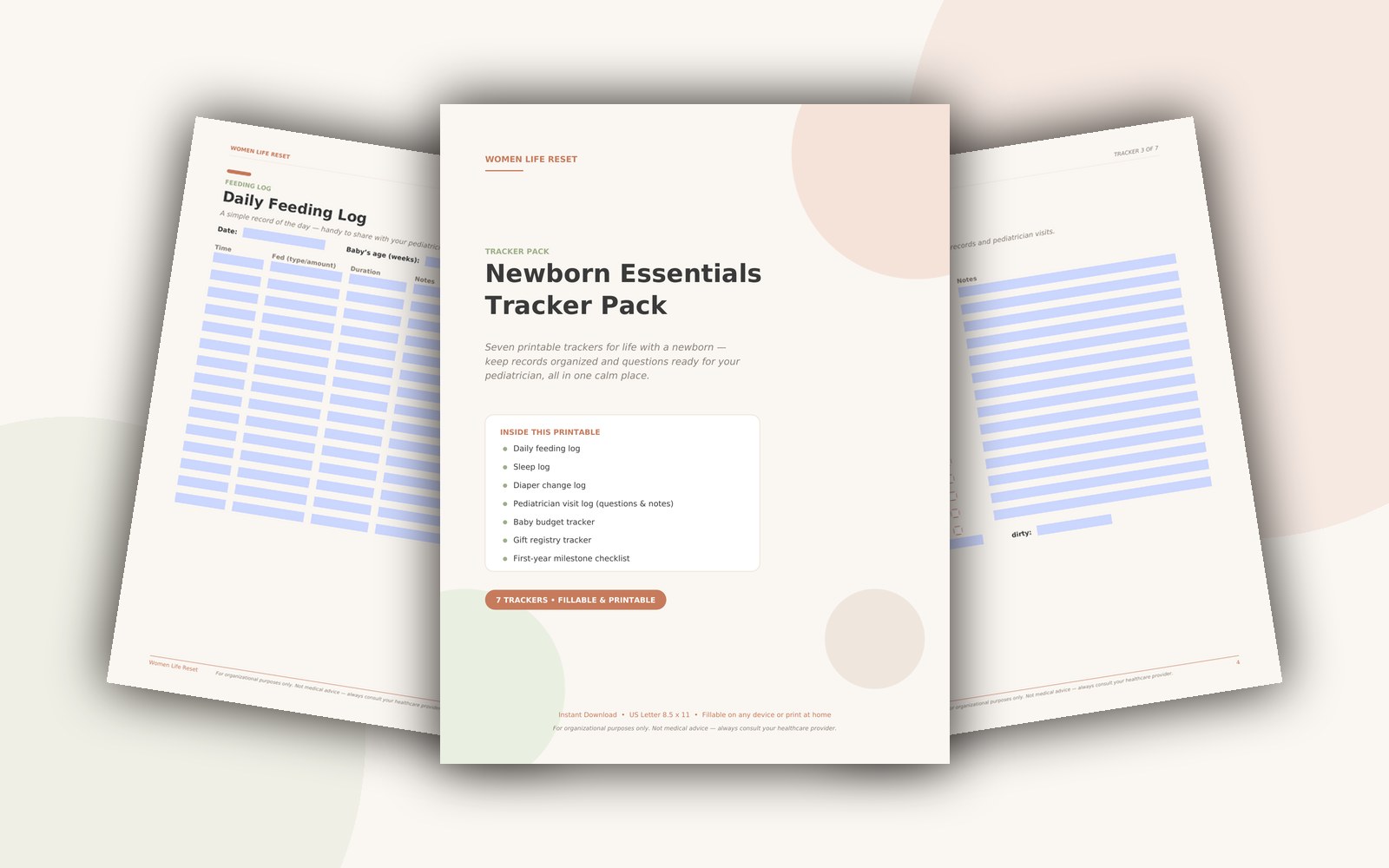 Newborn Essentials Tracker Pack
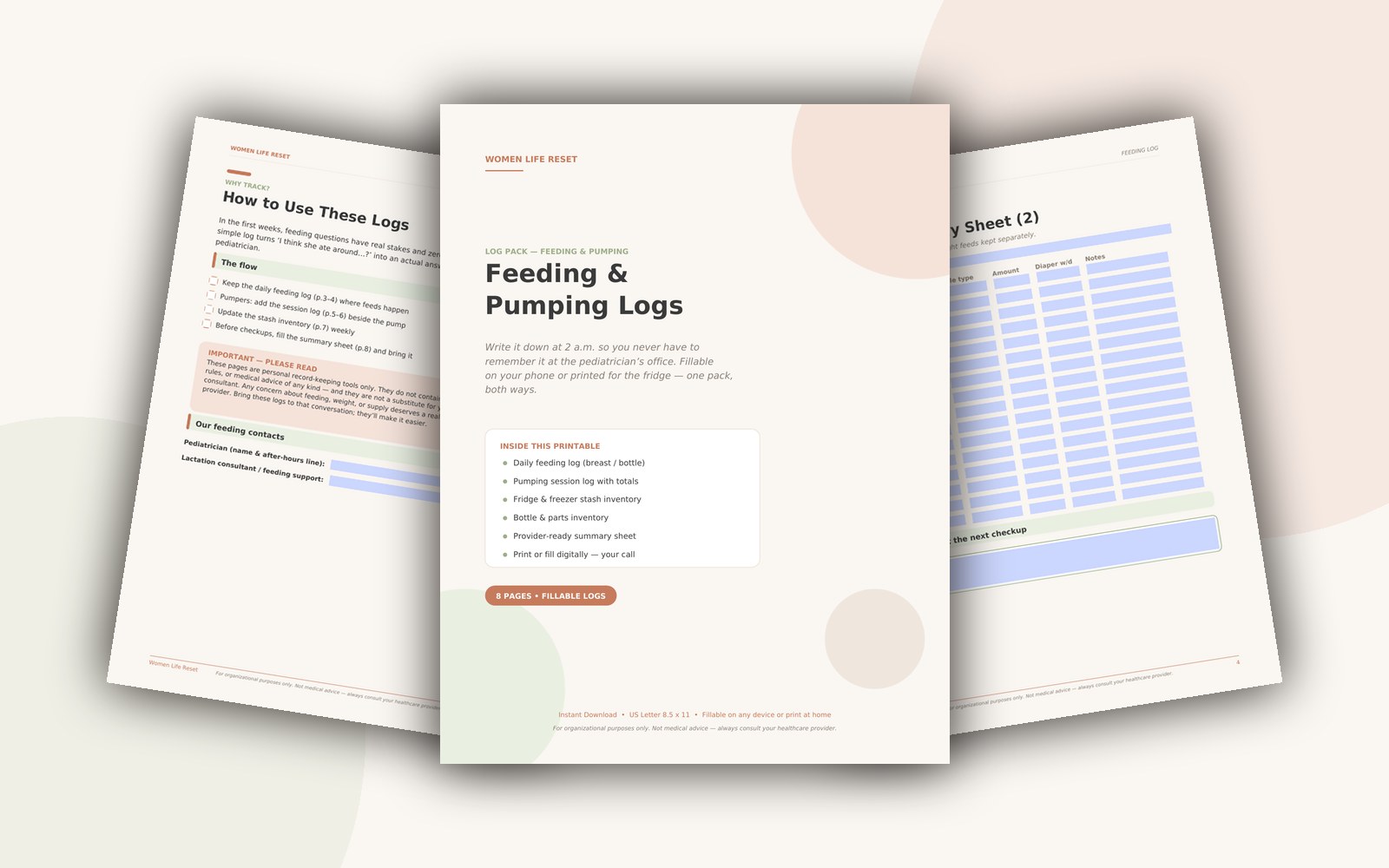 Feeding & Pumping Logs
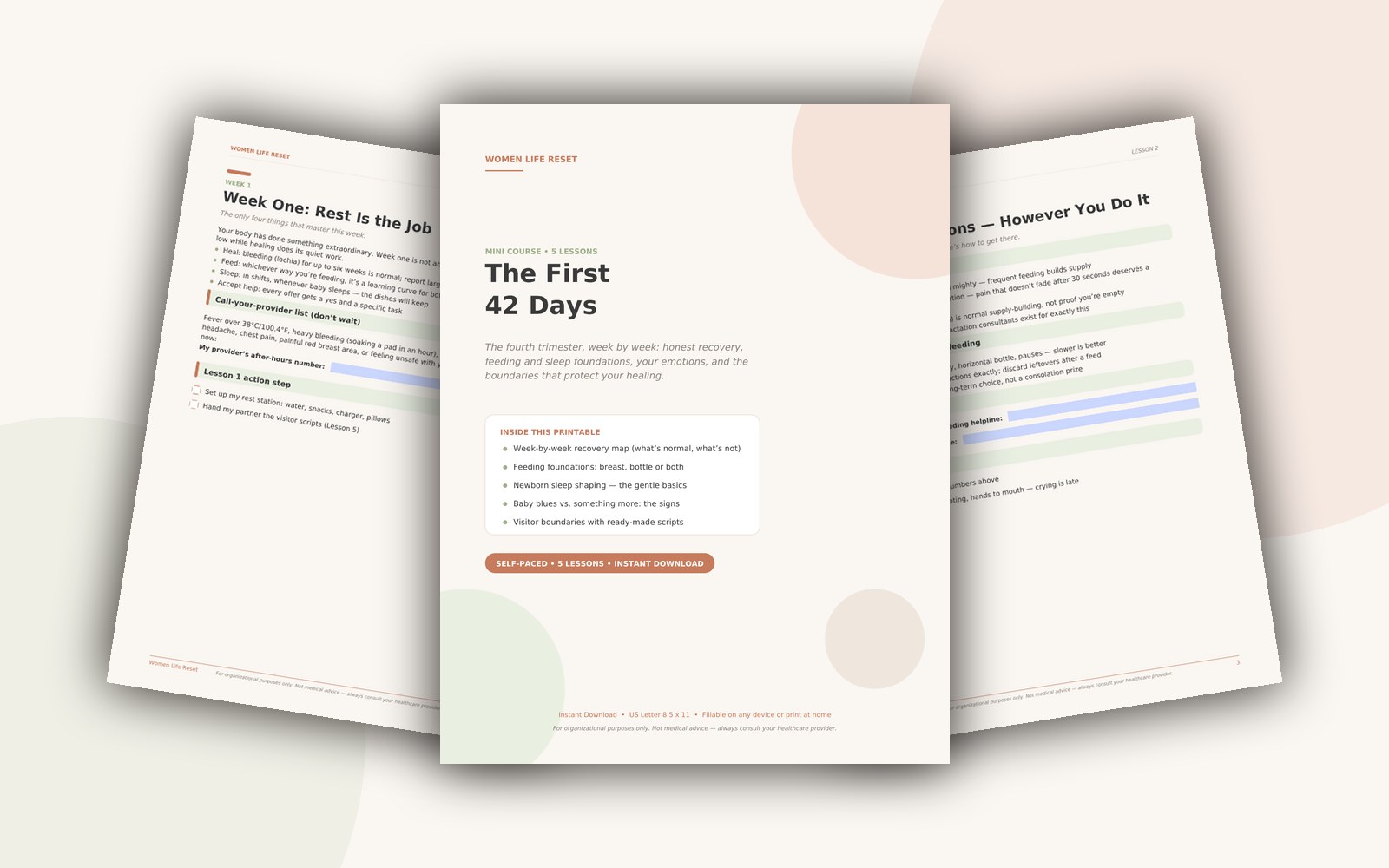 The First 42 Days
Packed the whole bag in one afternoon at 35 weeks — when my waters broke early I just grabbed it and went. It’s a plain checklist, nothing fancy, but it did its job when it mattered.
Popular on the blog



Fresh from the blog




Your 15% welcome code is waiting
Join the Mom Club and I’ll send you my First Trimester Checklist free, plus your standing code MOMCLUB15 — 15% off everything in the store, every time you shop. One gentle, practical email a week. That’s the whole deal.
No spam, no pressure — unsubscribe anytime and keep the checklist. Only gentle notes from me, Rahila.