

The Organized Postpartum: Meal Trains, Visitors and Recovery-Week Planning
Everyone plans for the birth. Almost nobody plans for the six weeks after — and then they find themselves at 10 p.m. on day four, texting “no you can’t visit Tuesday” while stirring pasta with one hand. The fix isn’t willpower; it’s logistics, set up before baby arrives when you still have a functioning prefrontal cortex.
This guide covers the three systems that make the “fourth trimester” dramatically calmer: the meal train, the visitor plan, and the help roster. Set them up around week 32–36 (they’re part of the bigger third trimester checklist plan), and your future self will send thank-you cards.
In this article
The heart of it
- Three systems cover everything: the meal train, the visitor plan, the help roster
- Set it all up before the birth — after is too late
- Boundary scripts let you protect recovery without damaging relationships
- The recovery-weeks framework matches help to what each week actually needs
- Solo parents and long-distance villages can build the same support, differently
System 1: The Meal Train
Hungry, tired parents + an empty fridge is the most predictable crisis in new parenthood. A meal train solves it with other people’s kindness, organized in advance.
How to set one up (20 minutes, week ~34):
- Choose a platform or a spreadsheet. Free meal-train websites handle scheduling and reminders automatically; a shared Google Sheet works too.
- Recruit a captain — a friend or relative who manages the calendar, so you’re not coordinating your own casserole supply. This is the key move; I skipped it the first time around and ended up scheduling dinner deliveries from the glider at 11 p.m.
- Set the schedule: dinners 3–5 nights a week for weeks 1–4 postpartum is the sweet spot. Fewer, spaced-out trains beat a first-week avalanche followed by silence.
- Post clear instructions: delivery window, “drop at door, no visit expected” note, dietary needs, and your preferred container situation.
- Layer in your freezer stock: the double-batch-a-week habit from trimester three fills the gaps between train days.
Quick copy-paste instruction for your train:
“Thank you so much for feeding us! Please drop off between 5–6 pm — we’ll leave a cooler by the door. No need to knock; we’re guarding naps fiercely. Dishes are disposable or we’ll return yours clean. We love you.”
System 2: The Visitor Plan
Visitors are lovely. Visitors are also exhausting. The plan isn’t about keeping people away — it’s about making every visit actually help.
Decide these five things with your partner before birth:
| Question | Example policy |
|---|---|
| When do visits start? | No visitors week 1; family only weeks 2–3; friends from week 4 |
| How long? | 45 minutes, hard stop |
| How are they scheduled? | One slot per day, texted the morning-of to confirm baby’s day is going okay |
| What’s the rule? | Visitors wash hands, don’t visit when sick, and bring food or do one chore |
| Who enforces it? | The partner — always the partner |
That last row matters most. The recovering parent should never be the one saying “time to go.” Agree on the enforcer role now, while it’s hypothetical and funny.
The golden visitor rule to share:A visit should leave the house better than it found it. Most friends are relieved to be told exactly how to help — hold the baby while you shower, fold the laundry, walk the dog. Publish the rule in your group chat and watch people rise to it.
System 3: The Help Roster
Beyond meals and visitors, there’s a category of help that needs scheduling, not vibes. List every recurring task in your household and pre-assign it:
- [ ] Pet care — who walks the dog week 1? Week 2?
- [ ] Older kids — school runs, activities, backup pickups (share the calendar with two trusted adults)
- [ ] Household ops — garbage day, mail, plant watering for any hospital stay
- [ ] Grocery runs — set up delivery or pickup accounts now, save your staple list, and hand the account to a helper
- [ ] The “call first” list — two or three people you can text at a hard moment who will actually show up
Free: the First Trimester Checklist
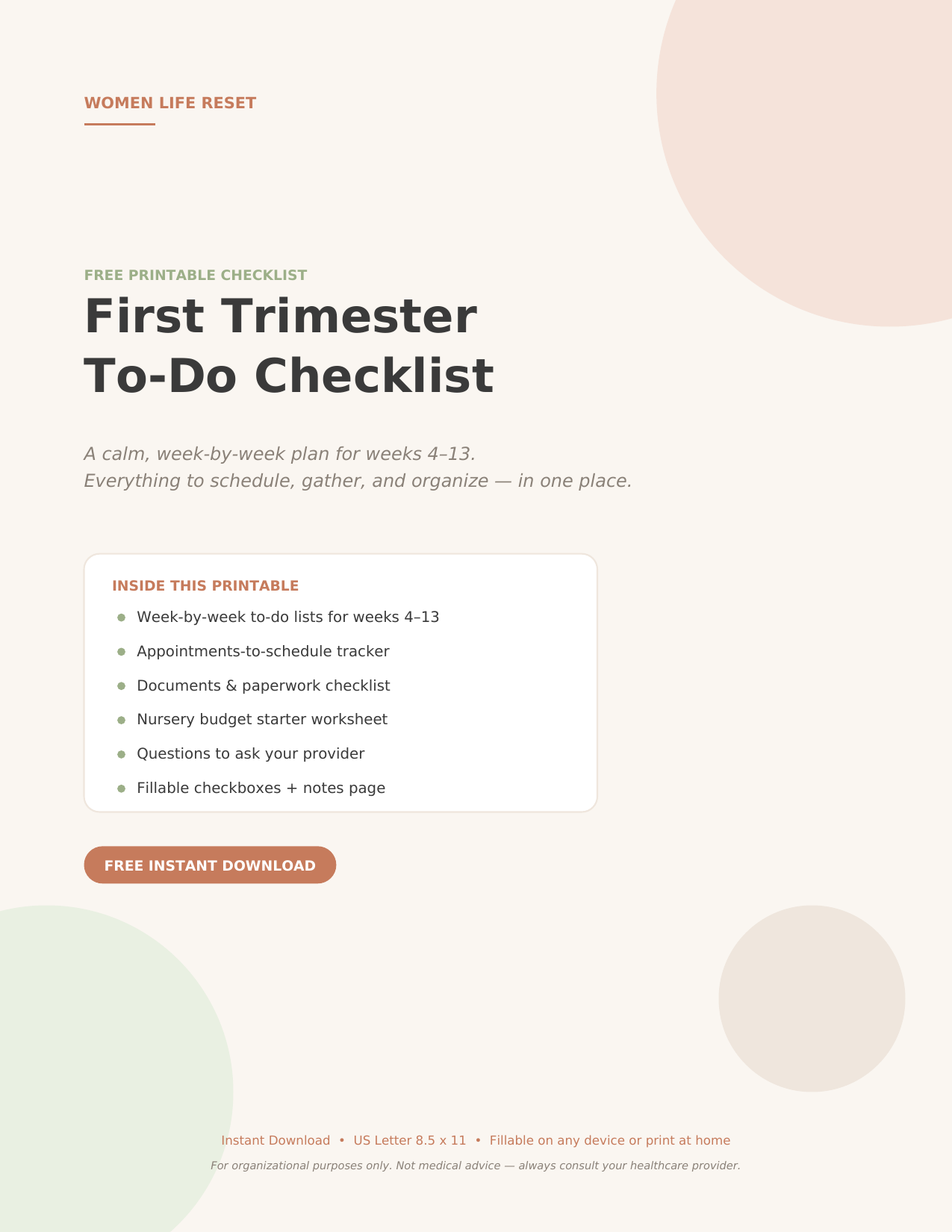
Weeks 1–13, gathered on four calm fillable pages — week-by-week to-dos, an appointment log, and room for your notes. It’s free.
The Recovery-Weeks Framework
Every family’s recovery looks different, and anything about your body belongs with your healthcare provider. But the logistics of recovery weeks are universal: protect sleep, reduce decisions, and keep the household running on rails.
Week 1: Survival mode. Meals from the train, no visitors, one job per adult: one on baby, one on everything else. Even swap shifts are fine — “off-duty” sleep is precious.
Weeks 2–3: Rhythms emerge. Begin family-only visits. One parent starts a daily out-of-house walk or errand. Track anything you want to discuss at upcoming pediatric or postpartum checkups — our newborn trackers guide covers simple logs you can bring to appointments.
Weeks 4–6: Re-entry. Widen the visitor circle, assess what’s working, and gently retire the systems you no longer need. Keep the grocery delivery — forever is fine.
The Pre-Birth Setup Checklist
- [ ] Meal train created + captain recruited (~week 34)
- [ ] Visitor policy decided + shared with family (~week 34)
- [ ] Help roster drafted + tasks assigned (~week 35)
- [ ] Grocery delivery account set up with saved staples list (~week 35)
- [ ] Freezer stocked with 8–10 labeled meals (~weeks 30–36, one double-batch a week)
- [ ] Partner briefed on enforcement duties (~week 36, over a nice dinner)
If You’re the Friend: How to Actually Help
Read this section if someone you love is expecting — or forward it strategically. The difference between “let me know if you need anything!” and real help is specificity:
- Take a concrete job: “I’m your meal-train captain” or “I’m on dog duty week one” lands better than a vague offer a new parent will never cash in.
- Use the door-drop protocol: food in the cooler, text on the way, zero expectation of seeing the baby. The visit and the delivery are separate events.
- Do the invisible tasks: taking out the trash you noticed, restocking the fruit bowl, loading the dishwasher before you leave.
- Remember week six. Everyone shows up in week one; the genuinely heroic friend brings dinner when the adrenaline has worn off.
- Ask about the parents, not just the baby. “How are you sleeping?” is a love language.
Boundary Scripts That Actually Work
Deciding boundaries is easy; saying them out loud is the hard part. Steal these:
- “We’re keeping week one just us — we’d love to see you the week after! What day works?”
- “Visits are 45 minutes these days — baby runs the schedule. We’ll text you when we’re up for one.”
- “We’d love help instead of holding time today — any chance you’d fold that basket while we chat?”
- “We’re not doing visits this week, but the meal calendar is in your inbox if you’d like to feed us — it genuinely saves our evenings.”
Kind, clear, and pre-written. Copy them into a note now so week-one-you only has to hit send.
For Solo Parents and Long-Distance Villages
These systems matter even more if your village is small or far away — they just get staffed differently:
- Paid help is a legitimate roster line. A postpartum doula, a cleaning service, or grocery delivery aren’t luxuries; they’re capacity. If the budget allows one support purchase, this is the category to consider — and a financial professional can help you weigh it.
- Virtual meal trains work. Long-distance friends can send delivery gift cards on a schedule; the captain coordinates from anywhere.
- Batch your video calls. The visitor plan applies on-screen too — scheduled calls beat a phone that rings during every nap.
- The “call first” list is non-negotiable. Everyone needs two or three humans who will show up, in person or on the phone, at a hard moment. Name them now.
The Takeaway
Postpartum calm isn’t a personality trait — it’s a meal calendar, a visitor policy, and a help roster, all built before you need them. Spend three evenings in trimester three setting up these systems, and the fourth trimester becomes what it should be: slow, snuggly, and gloriously uneventful.
Want It All in One Place?
All 25 pages — trimester checklists, weekly planner & newborn trackers — in one bundle. Save nearly half vs. buying separately.
Keep Every Week This Calm
The Digital New Mom Planner runs your first three months in fifteen minutes a day — meals, help, money and you, in one tap-to-jump place. Instant download.
This article is for organizational purposes only and isn’t medical advice — your healthcare provider knows your situation best.
These planners and trackers are organizational tools only and are not medical advice. Always consult your healthcare provider about your pregnancy and your baby’s care.
Quick answers
What is a meal train and how do I set one up?
Friends sign up to bring dinner on scheduled days — free sites like MealTrain.com coordinate it. Set yours up by week 36: 3 dinners a week for the first month changes everything.
How do I set visitor boundaries without offending people?
Decide the rules before birth, announce them once, and let your partner enforce them. A text template works: ‘We’re limiting visits to 30 minutes while we heal — we’d love to see you after week 3.’
What does postpartum recovery actually need?
Rest, food, hydration, and help with everything that isn’t feeding the baby. Organize your home so the recovery station — snacks, water, supplies — is within arm’s reach of where you’ll sit.
How do I set up a meal train without feeling awkward?
Ask one organised friend to run it — people genuinely want to help and just need a slot and a rule (drop at the door, no visit required). Two to three dinners a week for the first month is the sweet spot. Saying yes to help is a skill; practice early.
How long should visitors stay in the early weeks?
Twenty to forty minutes is kind to everyone — long enough to meet the baby, short enough to protect feeds and naps. Say the boundary warmly and in advance: “We’d love you to meet her — short visits while we find our feet.” Most people are relieved by clear instructions.
Educational only — not medical advice. Always consult your healthcare provider.
One calm email a week
Gentle, practical organization for pregnancy and new motherhood — start with the free First Trimester Checklist (instant download, no account needed).
Free instant download · Opens right in your browser · No Canva account needed
Subscriber perk: private coupon codes by email — our list never pays full price
Make this week easier
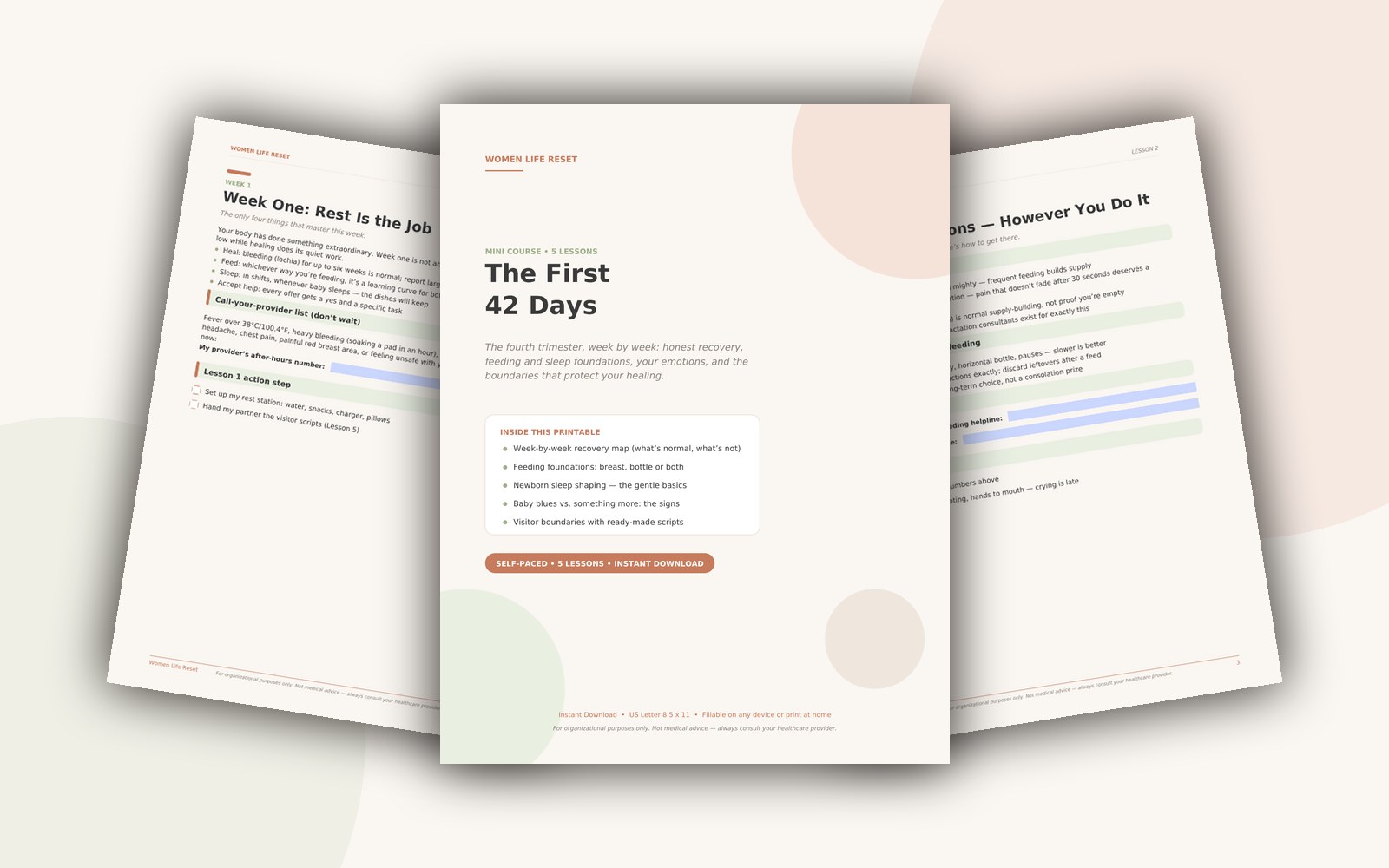 The First 42 Days
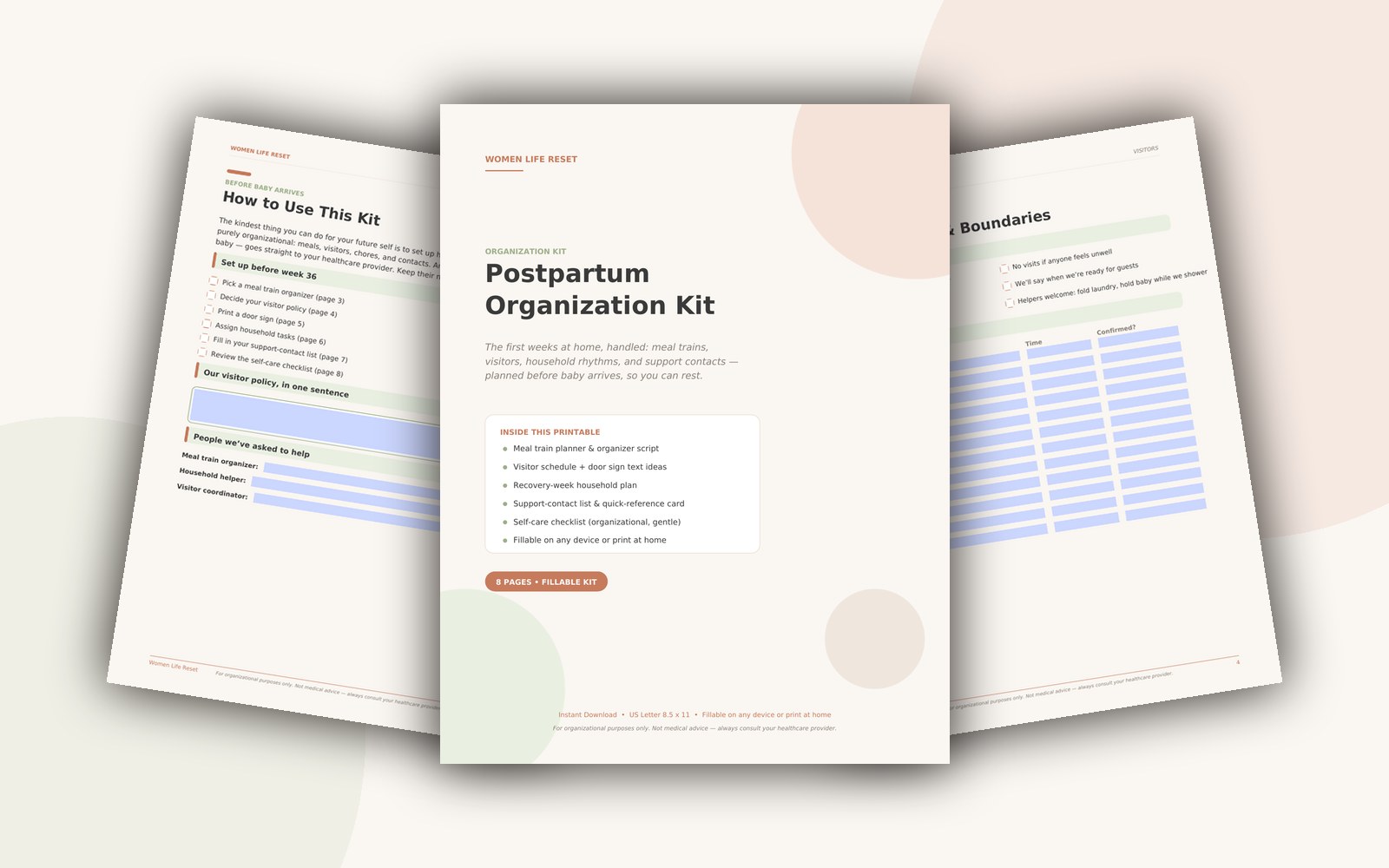 Postpartum Organization Kit
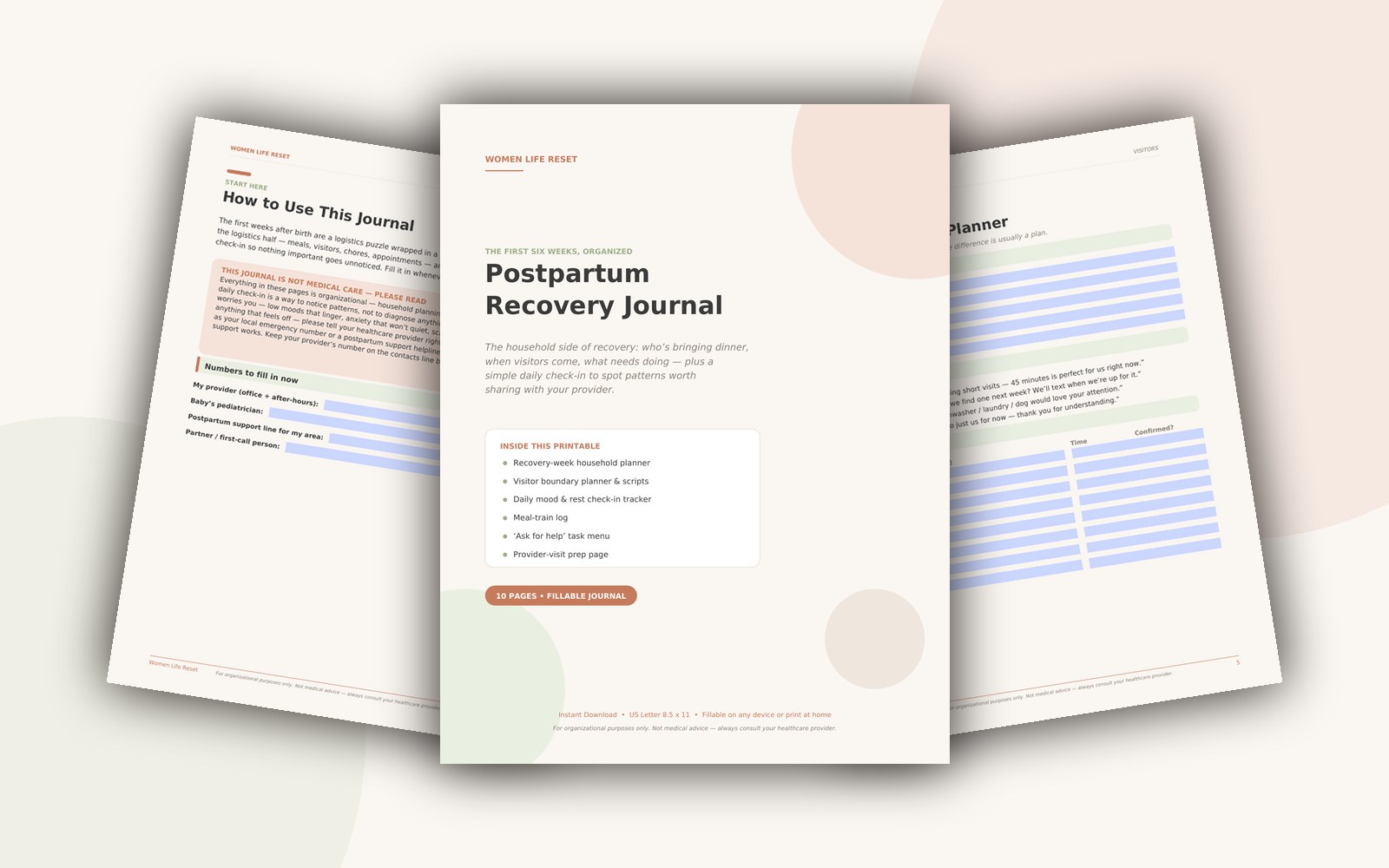 Postpartum Recovery Journal
I was terrified of labour. The breathing sections changed everything — I walked in actually feeling ready. My midwife asked where I learned it.
Popular on the blog




Fresh from the blog




Your 15% welcome code is waiting
Join the Mom Club and I’ll send you my First Trimester Checklist free, plus your standing code MOMCLUB15 — 15% off everything in the store, every time you shop. One gentle, practical email a week. That’s the whole deal.
No spam, no pressure — unsubscribe anytime and keep the checklist. Only gentle notes from me, Rahila.