

First Trimester To-Do List: The Complete Week-by-Week Organization Guide
You just saw two lines on a test, and your brain immediately split into two tabs: “pure joy” and “pure chaos.” Totally normal. The first trimester (weeks 1–13) comes with a surprising amount of admin — appointments to book, records to gather, money questions to sort — and most of it is far less overwhelming when it’s written down in the right order.
I remember lying awake at 2 a.m. during my first pregnancy, mentally re-listing everything I hadn’t done yet — and I promised myself I’d never run a pregnancy from memory again. So that’s exactly what this guide is: a calm, week-by-week first trimester checklist that tells you what to organize and when, so nothing rattles around in your head at 3 a.m. Bookmark it, print it, or grab the free fillable version below.
In this article
The heart of it
- Set up one pregnancy command center — paper, digital, or hybrid — before anything else
- Weeks 1–4: confirm, record, breathe; weeks 5–8: appointments and paperwork; weeks 9–13: decisions and announcements
- One folder for money and admin saves hours of hunting later
- Bring a written questions list to every appointment — pregnancy brain is real
- Pick your system once and commit; switching mid-trimester is where things get lost
Before You Start: Set Up a Pregnancy Command Center
Ten minutes of setup now saves hours of hunting later. Choose one home for everything pregnancy-related:
- A folder or binder (physical or digital) for test results paperwork, appointment printouts, and insurance documents
- A notes page for questions you want to ask your provider — because you will forget them in the exam room
- A calendar system you already use, with a repeating weekly 10-minute “pregnancy admin” slot
- A budget tab — even a simple spreadsheet — for upcoming costs (more on that below, and in our baby budget planner guide)
If you like pen and paper, a dedicated pregnancy journal (like our Pregnancy Journal) keeps memories and logistics in one pretty place. If you’re a phone person, a single note titled “Pregnancy HQ” works just as well.
Weeks 1–4: Confirm, Record, Breathe
You may not even know you’re pregnant yet in this window — and that’s fine. Once you suspect or confirm:
- [ ] Note the first day of your last period. This is the date providers use to estimate your due date, so write it somewhere you won’t lose it.
- [ ] Record the date of your positive test and any details worth remembering.
- [ ] Call to schedule your first prenatal appointment. Many offices book weeks out, so this call is your first real to-do.
- [ ] Start your questions list. Anything you’re wondering about — medications you take, lifestyle questions, what to expect — goes on the list for your provider.
- [ ] Check your insurance basics. Which providers and hospitals are in-network? What’s the maternity coverage phone number? Just note where the answers live for now.
- [ ] Decide who knows. You don’t owe anyone an announcement timeline. Jot down your “inner circle” plan so the decision is made once, not daily.
Weeks 5–8: Appointments and Paperwork
This is usually when the first prenatal visit happens and the paperwork pile starts.
- [ ] Attend your first appointment — bring your questions list, your dates, your insurance card, and a way to take notes.
- [ ] File everything the same day. Lab orders, visit summaries, due-date estimates — straight into your command center.
- [ ] Request your medical records if you’ve changed providers or have relevant history elsewhere. Offices can take weeks to send them.
- [ ] Map out the appointment cadence. Ask how often visits typically happen and pencil them into your calendar now.
- [ ] Look into workplace policies. Find your employee handbook section on parental leave and note who in HR handles it. No action needed yet — just know where it lives.
- [ ] Start a simple symptom/note log. Not to self-diagnose — just so you can answer “how have you been feeling?” accurately at each visit.
Free: the First Trimester Checklist
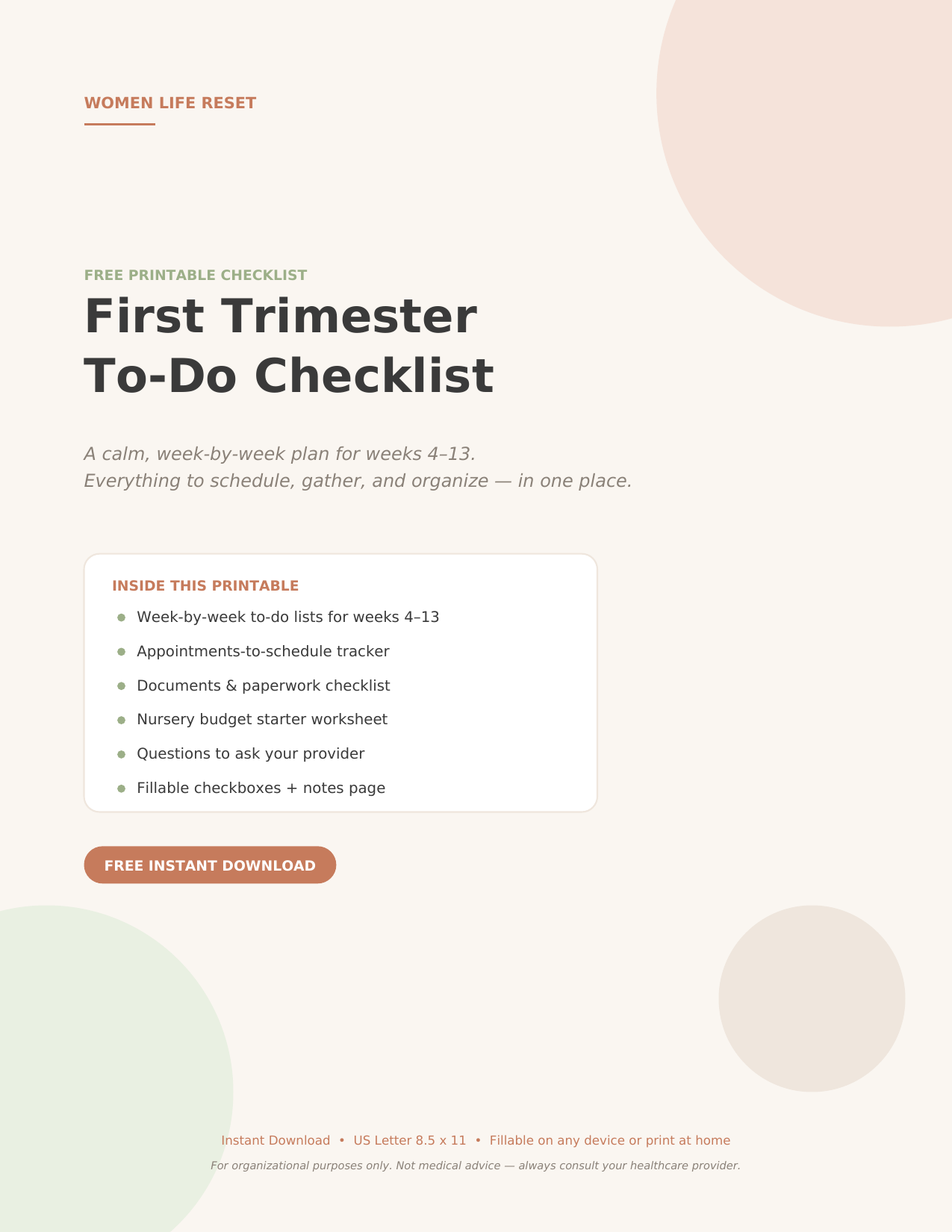
Weeks 1–13, gathered on four calm fillable pages — week-by-week to-dos, an appointment log, and room for your notes. It’s free.
Weeks 9–13: Decisions, Announcements and Looking Ahead
The end of the first trimester is when many families start sharing news and thinking ahead.
- [ ] Plan your announcement (if you want one). Who gets told in person, who gets a call, and roughly when. Write it down so no one gets accidentally skipped.
- [ ] Review your budget tab. Add any known upcoming costs — appointment copays, classes, the nursery fund — so nothing sneaks up on you.
- [ ] Research birthing location options if you have a choice (hospital, birth center). You don’t need to decide yet; a pros-and-cons page is enough.
- [ ] Look at childbirth class schedules. Popular ones fill early — note registration dates even if you’re not ready to book.
- [ ] Start a “later” list. Things like registry ideas, maternity leave dates, and childcare research all belong in the second trimester. Parking them on a list gets them out of your head. (Our second trimester checklist guide picks up right where this one leaves off.)
- [ ] Book anything with a waitlist — some providers, doulas, and classes have them.
The Money & Admin Corner
Not glamorous, but future-you will be grateful:
| Task | When | Why it helps |
|---|---|---|
| Confirm maternity coverage details | Weeks 5–8 | No surprise bills later |
| Note FMLA/leave eligibility dates | Weeks 5–8 | Tells you when to notify work |
| Open a “baby” sinking fund | Any week | Small, regular transfers add up |
| List predictable costs (classes, gear, copays) | Weeks 9–13 | Turns vague worry into numbers |
For a full first-year cost breakdown, see our baby budget planner.
Questions to Bring to Your Provider
Your provider is the right source for anything medical. Your job is simply to arrive organized. Starter prompts for your list:
- Which of my current medications, supplements, or routines should we discuss?
- What symptoms warrant a call to your office versus waiting for the next visit?
- What’s the schedule of typical appointments, screenings, and tests?
- Who do I call after hours, and what’s the best way to reach the office?
- Are there classes or resources your practice recommends?
Add your own as they pop up — that running list is one of the most useful organizational tools you’ll keep all pregnancy.
Your First Trimester Checklist at a Glance
| Week range | Top 3 priorities |
|---|---|
| 1–4 | Log key dates · Book first appointment · Start questions list |
| 5–8 | First visit + file paperwork · Insurance review · Request records |
| 9–13 | Announcement plan · Budget review · “Later” list for trimester two |
Printable, Digital or Hybrid: Pick Your System
There’s no perfect format — only the one you’ll actually open. A quick decision guide:
- Paper binder: best if you think with a pen and want something to physically carry to appointments. Add sheet protectors for hospital paperwork.
- Digital folder + notes app: best if your phone is always in reach. One cloud folder named “Baby,” one running note for questions, done.
- Hybrid (our favorite): digital for scheduling and budgets, paper for the questions list and anything you hand across a desk. Five minutes to set up, zero maintenance guilt.
Common First-Trimester Organization Mistakes
- Doing everything in week five. Early pregnancy is for a handful of calls and a folder — not a complete nursery plan. Pace the list.
- Keeping dates in your head. Due-date math and appointment times belong in a calendar with reminders, not in memory.
- Starting five tracking systems. Pick one place for notes. Fragmentation is where checklists go to die.
- Researching purchases now. Gear research is a second-trimester job. Parking it on the “later” list is a feature, not procrastination.
What Comes Next
The second trimester is famously the “feel good” stretch — and the perfect time to get ahead on showers, nursery planning, and bigger decisions. When you’re ready, head to our second trimester checklist.
One last tip: the moms who feel calmest aren’t the ones who did the most — they’re the ones who wrote it down. Ten minutes a week with a checklist beats a Sunday spiral every time.
Keep Every Week This Calm
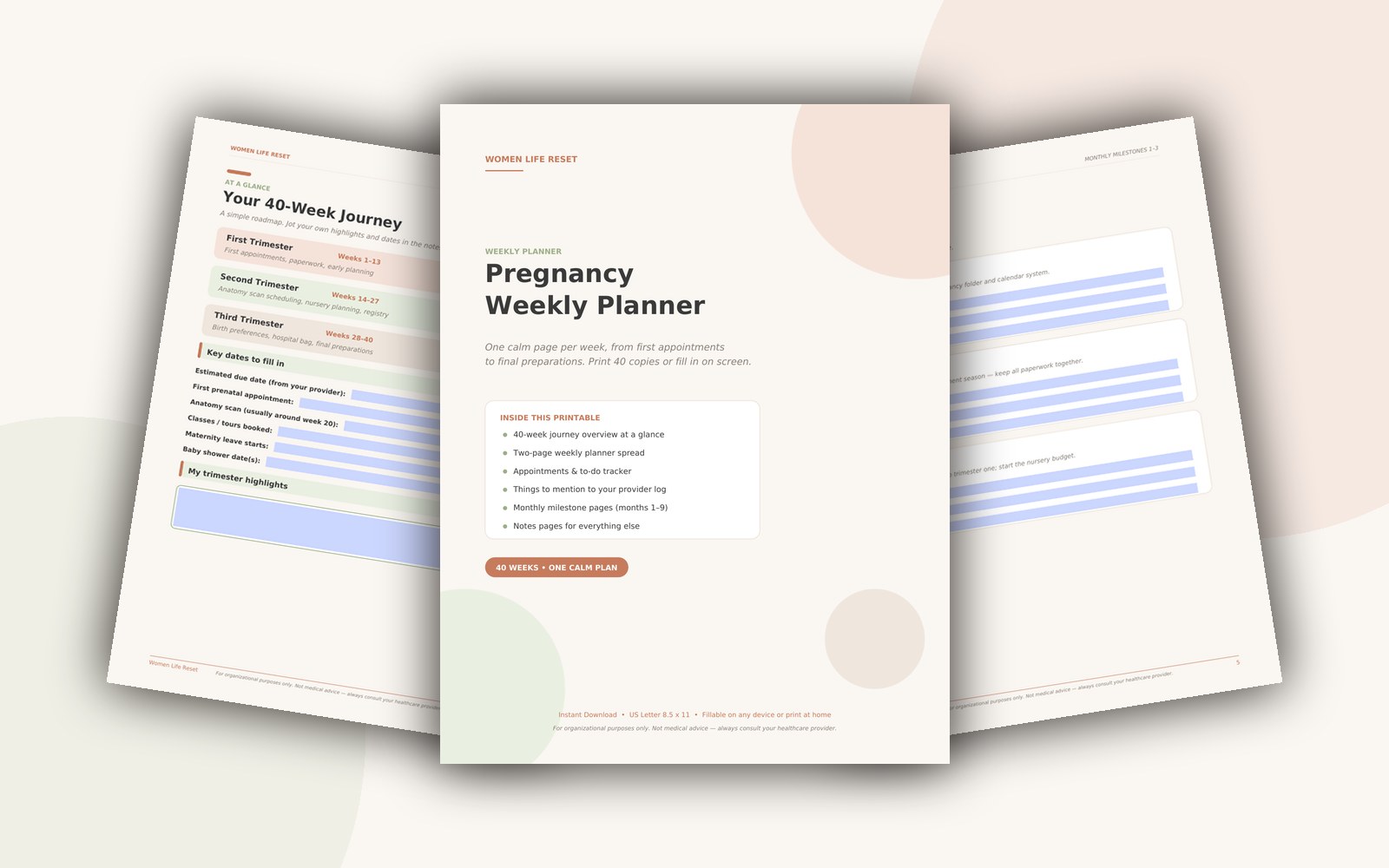
The Pregnancy Weekly Planner turns these tips into a five-minute Sunday ritual — 10 printable pages for appointments, to-dos, questions, and milestones. Instant download.
This article is for organizational purposes only and isn’t medical advice — your healthcare provider knows your situation best.
These planners and trackers are organizational tools only and are not medical advice. Always consult your healthcare provider about your pregnancy and your baby’s care.
Quick answers
What should I do first after a positive pregnancy test?
Call your provider to book a first appointment (usually around week 8), start a prenatal vitamin with folate if you haven’t, and write down the first day of your last period — that’s the date every provider will ask for.
When is the first prenatal appointment?
Most providers schedule the first visit between weeks 8 and 10. If you have a medical condition, previous loss, or concerning symptoms, call sooner — they’ll often see you earlier.
What actually matters in the first trimester?
Three things: prenatal vitamins, your first appointment, and rest. Everything else — registries, nurseries, announcements — can wait until you feel better in the second trimester.
What are the most important first trimester to-dos?
The short list: book your first midwife or doctor appointment, start a prenatal vitamin with folic acid if you haven’t, and note key dates. Everything else can wait a week. The checklist orders it all, so you never face the whole list at once.
When is the first prenatal appointment usually?
Typically between 8 and 12 weeks, though it varies by provider and situation. Call as soon as you have a positive test — some practices book out weeks ahead. Bring your questions written down; first appointments cover a lot quickly.
Educational only — not medical advice. Always consult your healthcare provider.
One calm email a week
Gentle, practical organization for pregnancy and new motherhood — start with the free First Trimester Checklist (instant download, no account needed).
Free instant download · Opens right in your browser · No Canva account needed
Subscriber perk: private coupon codes by email — our list never pays full price
Make this week easier
 Pregnancy Weekly Planner
 Two Pink Lines
 Pregnancy Journal
Two Sunday afternoons = a month of dinners in the freezer. At 2 weeks postpartum I cried with gratitude at past me. Buy it before the baby comes.
Popular on the blog




Fresh from the blog


Your 15% welcome code is waiting
Join the Mom Club and I’ll send you my First Trimester Checklist free, plus your standing code MOMCLUB15 — 15% off everything in the store, every time you shop. One gentle, practical email a week. That’s the whole deal.
No spam, no pressure — unsubscribe anytime and keep the checklist. Only gentle notes from me, Rahila.