

How to Build a Birth Plan: A Simple Organization Framework
Here’s a secret experienced moms will tell you: a birth plan isn’t really a plan — birth famously refuses to follow scripts. What it actually is, is a communication tool. It’s one or two pages that tell your care team what matters to you, so you’re not trying to explain your preferences between contractions.
I skipped this step with my first baby and spent early labor trying to explain my preferences between contractions — never again. That reframing makes the whole project much less intimidating, and this guide gives you a simple organizational framework for building yours: what sections to include, how to keep it flexible, and which questions belong in a conversation with your provider (because anything medical is their lane, not ours).
In this article
The heart of it
- Think birth preferences, not script — labor is famously unscripted
- Three pages maximum; one is even better
- Six sections cover everything: environment, comfort, monitoring, pushing, first hour, plan B
- Draft, discuss with your provider, print, share — in that order
- A plan-B mindset is the most useful line on the page
First, Rename It in Your Head
Many hospitals and doulas now prefer the term birth preferences — and it’s worth adopting. “Preferences” reminds everyone (including you) that this document describes your ideal scenario, not a contract. Going in with organized preferences and a flexible mindset is the sweet spot.
The 3-Page-Max Rule
Labor and delivery teams are busy. A birth plan that gets read is a birth plan that’s short. Your organizing constraints:
- One page, two max. Bullet points, not paragraphs.
- Headers your nurse can scan. Think: environment, labor, delivery, after birth, baby care.
- Plain language. Skip medical jargon you picked up from forums — your provider’s vocabulary is the one that matters.
- A “if things change” line. One sentence acknowledging you’re open to adjusting if your care team recommends it. It sets a collaborative tone.
The Framework: Six Sections to Organize
Work through these one at a time. For each, jot down what you’d prefer — and leave out anything you genuinely don’t care about. Fewer items means more attention on the ones that matter.
1. The Basics (Top of Page)
- Your name, your partner/support person’s name, your provider’s name
- Due date and where you’re delivering
- Anything your team should know up front (allergies, relevant history — confirm with your provider what belongs here)
2. Labor Environment
- Lighting, music, quiet vs. chatty — what’s your vibe?
- Who’s in the room? (Partner, doula, family, students yes/no)
- Photos/video preferences
- What you’re bringing (own pillow, robe, playlist)
3. Labor Preferences
- Movement: walking, shower, birth ball — note what you’d like available
- Pain management: this is a conversation with your provider, not a decision to make from an article. Write down what you’d like to discuss — options, timing, your questions — and bring it to a prenatal visit.
- Monitoring and interventions: same rule. List your questions here and let your provider explain what’s standard at your birth location.
4. Delivery Preferences
- Positions you’d like to try (ask your provider what’s supported)
- Who cuts the cord, immediate skin-to-skin preferences
- Mirror, music, announcement of the baby’s sex — the little moments that matter to you
5. After Birth & Baby Care
- Feeding intentions (and a note that you’d like support — e.g., lactation resources — if wanted)
- Rooming-in preferences
- Any newborn procedures you have questions about — flag these for your provider or pediatrician ahead of time
6. The Contingency Corner
One short section for “if a cesarean becomes necessary” or “if plans change” preferences: who stays with baby, whether you’d like the curtain lowered, etc. You may never need it — but deciding calmly at 34 weeks beats deciding in the moment.
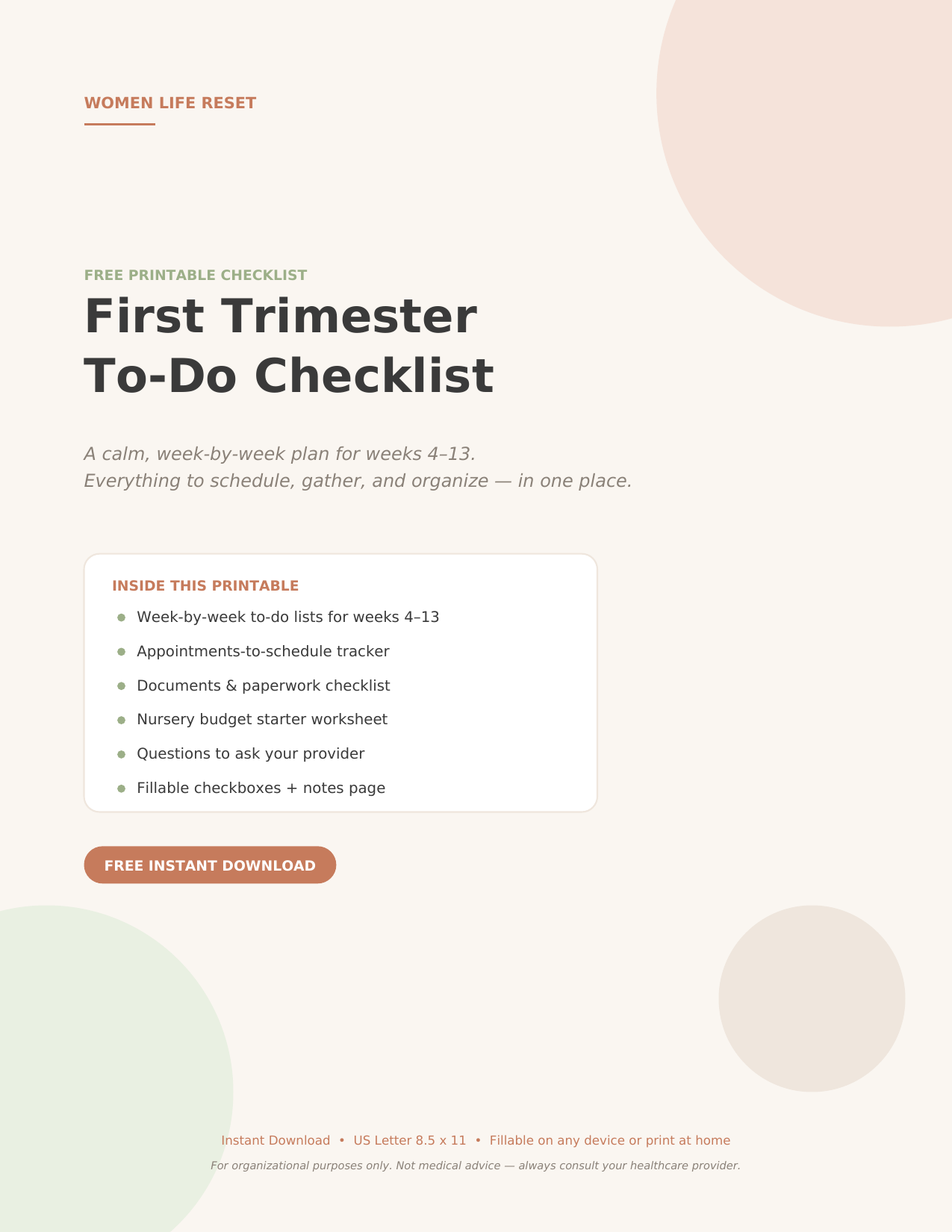
Free: the First Trimester Checklist
Weeks 1–13, gathered on four calm fillable pages — week-by-week to-dos, an appointment log, and room for your notes. It’s free.
Draft It Like This: A 5-Step Workflow
- Brain dump (week ~28–30): every preference you’ve seen or heard about, no filtering.
- Sort into the six sections above.
- Cut ruthlessly. If you don’t feel strongly, delete it. Aim for 3–5 bullets per section.
- Review with your provider (week ~32–36). Ask: “Is anything here unrealistic for this hospital?” and “What questions on my list can you help me think through?” Revise based on their answers.
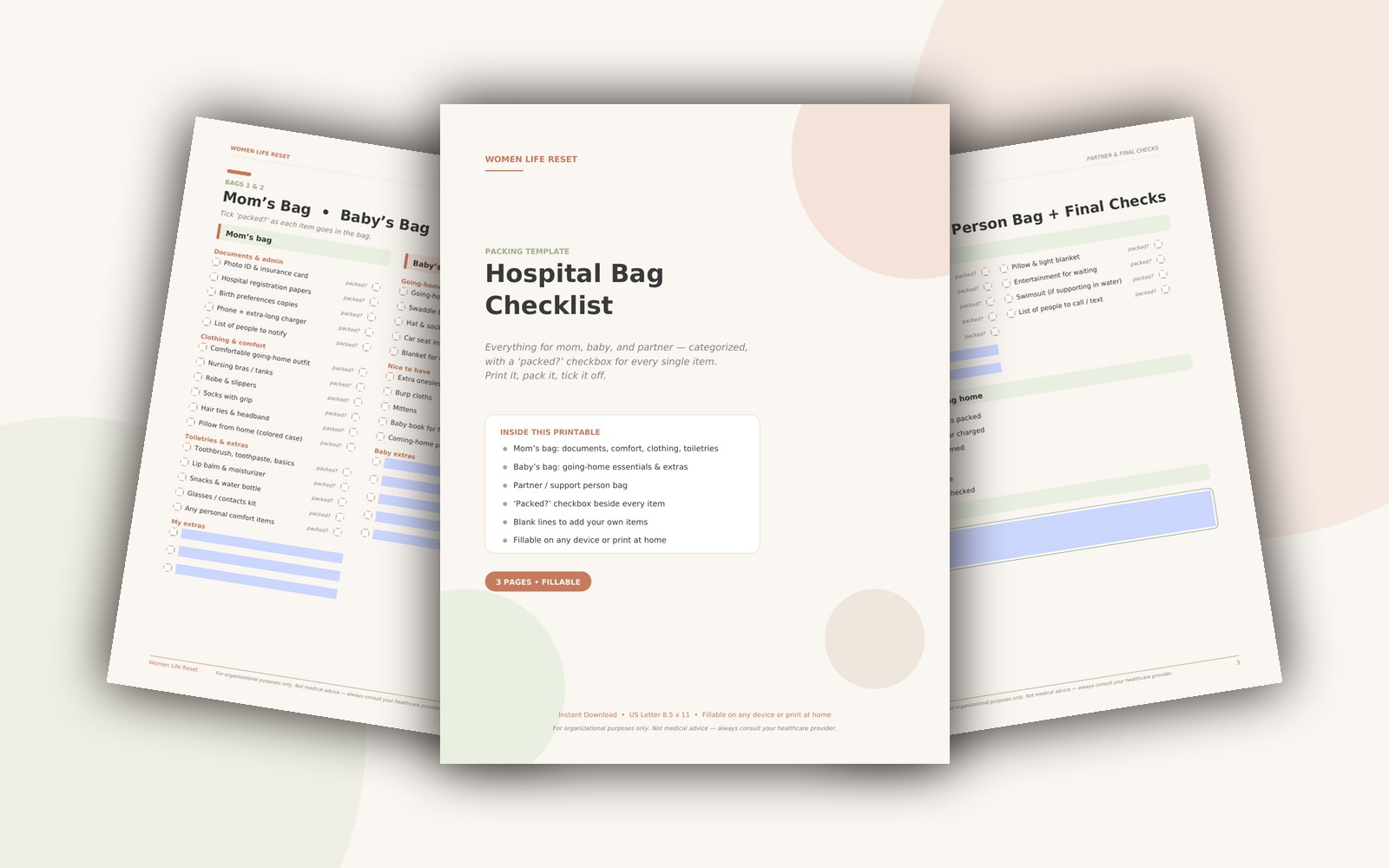
- Print 3–4 copies: one for your chart, one for your hospital bag, one for your partner, one spare. (Yes — put it in the bag now. Our hospital bag checklist has a documents section for exactly this.)
Questions to Ask Your Provider Before Finalizing
- What’s standard practice at my birth location for the items on my list?
- Which of my preferences might need adjusting, and why?
- How is the birth plan shared with the on-call team if you’re not there?
- Are there options I haven’t listed that I should know about?
- Who should I give copies to, and when?
Common Mistakes to Skip
- Copying a stranger’s 6-page plan from the internet. Your plan should reflect your priorities, in your provider’s language.
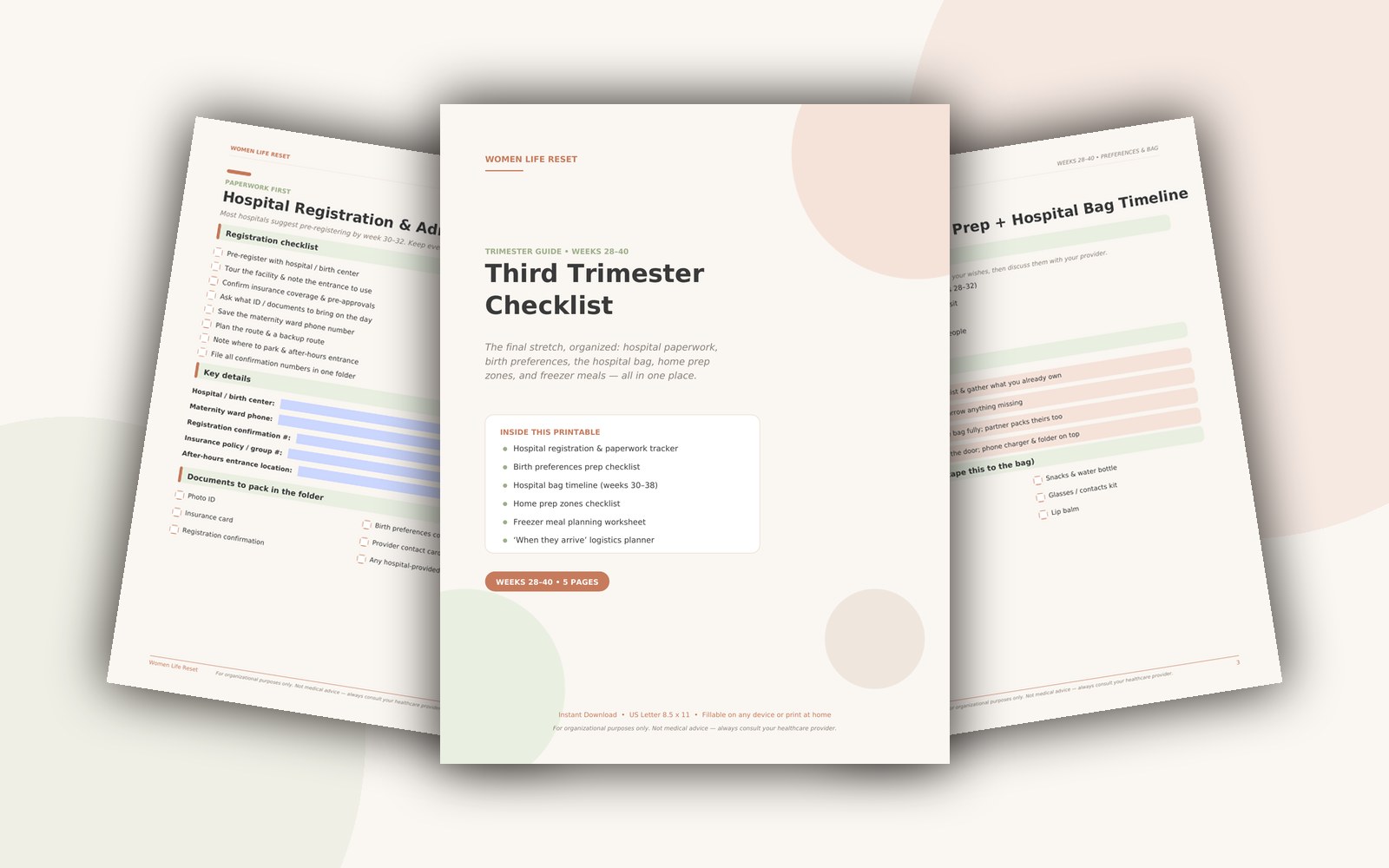
- Writing it the week of your due date. Start in the early third trimester so there’s time for the provider conversation. (It’s one of the anchor tasks in our third trimester checklist.)
- Treating it as fixed. The plan serves you — not the other way around.
A Sample Birth Preferences Snapshot
To show how short “short” really is, here’s the skeleton of a finished one-pager (your version gets reviewed with your provider before it’s final):
The Basics — Jane D., due Oct 28, delivering at Riverside with Dr. Lee. Support person: Alex (spouse).
Environment — Dim lights, our playlist, minimal extra staff please; okay with photos taken by Alex.
Labor — We’d like to move around as much as possible; we’ll discuss pain-management options with the team as labor progresses.
Delivery — Immediate skin-to-skin if all is well; Alex would like to cut the cord.
After birth — We plan to breastfeed and would appreciate lactation support; baby rooms in with us.
If plans change — We trust the team’s guidance; Alex stays with baby if we’re separated.
Six sections, roughly 120 words. That’s the whole document — everything else is conversation.
Birth Plan FAQ
Do I need one if I’m having a planned cesarean?
Yes, and it’s arguably more useful — your preferences for the operating room environment, who announces the baby, and immediate skin-to-skin are exactly the details a short document communicates well. Ask your provider what choices exist at your facility.
What if my provider isn’t on call when I deliver?
That’s precisely what the printed copies solve. A one-pager in your chart and one taped to your bag means the on-call team gets your priorities without you reciting anything.
Can I change my mind — even mid-labor?
Absolutely. Preferences are a starting point for conversation, never a cage. Tell your nurse what you’d like to adjust; flexibility is built into the document by design.
Is a birth plan mandatory?
No. Plenty of parents skip it. But the process of building one — thinking through scenarios, asking your provider questions — is where the real value lives. The paper is a bonus.
Sharing the Plan With Your Village
The document only works if the right people have seen it before the big day. A quick distribution checklist:
- Your provider gets a copy at the review appointment — ask whether it goes into your chart electronically or whether you should bring printed copies.
- Your support person should read it fully and keep a photo on their phone; they’re your advocate if you’re busy doing something more important, like labor.
- Your doula or backup support, if you have one, gets a copy in advance with a chance to ask questions.
- The hospital bag copy lives in the front pocket, on top, where a tired partner can find it without excavation.
Resist the urge to text it to the whole family. The plan is a working document for your care team — everyone else can hear about it afterward.
The Takeaway
A good birth plan is short, scannable, reviewed with your provider, and printed before your hospital bag is zipped. Build it with the framework above and you’ll walk in feeling prepared instead of hoping for the best — which is really all any of us can do.
Want It All in One Place?
All 25 pages — trimester checklists, weekly planner & newborn trackers — in one bundle. Save nearly half vs. buying separately.
Keep Every Week This Calm
The Birth Plan Guide turns this framework into a finished plan — fillable pages with calm wording for every choice. Instant download.
This article is for organizational purposes only and isn’t medical advice — your healthcare provider knows your situation best.
These planners and trackers are organizational tools only and are not medical advice. Always consult your healthcare provider about your pregnancy and your baby’s care.
Quick answers
How long should a birth plan be?
One page. Nurses and midwives consistently say they read short, prioritized plans. Lead with your three non-negotiables, then group the rest under labor, delivery, and after birth.
When should I write my birth plan?
Weeks 28-32 are ideal: late enough that you know your provider and your pregnancy, early enough to discuss it at an appointment and adjust before the big day.
What if my birth doesn’t follow the plan?
That’s normal — treat the plan as preferences, not orders. The most useful line on any birth plan is how you want decisions communicated to you when things change.
Should I share my birth plan with my birth partner?
Yes — walk through it together before labour. Your partner is your advocate in the room, and a plan they’ve only skimmed is hard to defend under pressure. Go through each choice, explain the why behind the important ones, and agree on what flexibility looks like.
Can I change my mind during labour?
Absolutely — a birth plan states preferences, not promises. You can decline, request or change anything at any point, and good care teams expect it. The plan’s real job is helping you think through decisions calmly now, so choices in the moment are easier, not locked in.
Educational only — not medical advice. Always consult your healthcare provider.
One calm email a week
Gentle, practical organization for pregnancy and new motherhood — start with the free First Trimester Checklist (instant download, no account needed).
Free instant download · Opens right in your browser · No Canva account needed
Subscriber perk: private coupon codes by email — our list never pays full price
Make this week easier
 Hospital Bag Checklist
 The Calm Birth Course
 Third Trimester Checklist
Those first weeks are a blur and this course felt like a friend who had done it before. The feeding and sleep lessons saved us — I re-read them at 3am more than once.
Popular on the blog




Fresh from the blog



Your 15% welcome code is waiting
Join the Mom Club and I’ll send you my First Trimester Checklist free, plus your standing code MOMCLUB15 — 15% off everything in the store, every time you shop. One gentle, practical email a week. That’s the whole deal.
No spam, no pressure — unsubscribe anytime and keep the checklist. Only gentle notes from me, Rahila.