
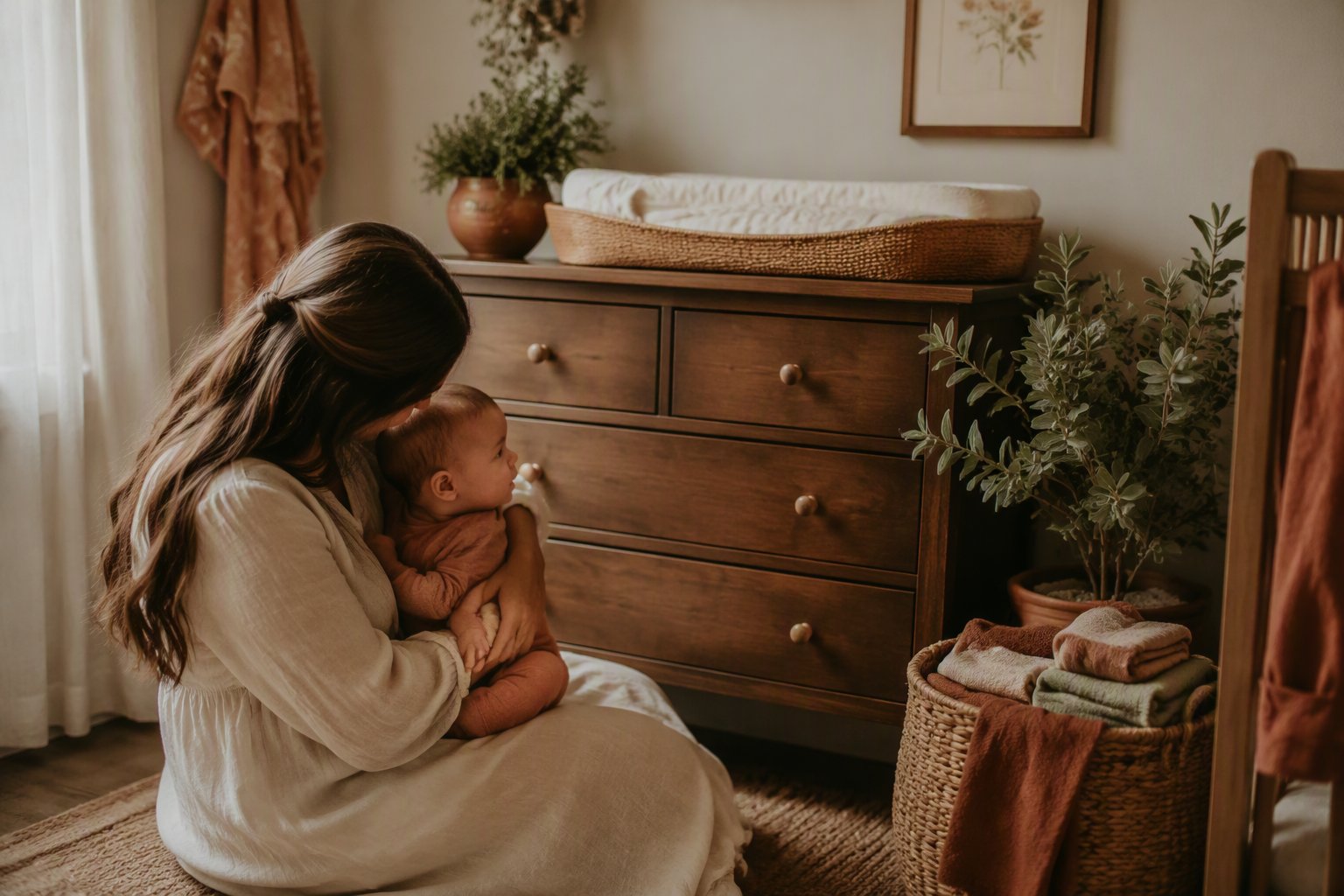
Nursery on a Budget: 10 Ways to Save Without Sacrificing Style
$2,400. That’s the price tag hiding inside the nursery photo you saved at 1 a.m. — the one with the linen glider, the hand-knotted rug, and a mobile that costs more than your first car payment. And here’s the quiet truth about that photo: the baby in it has no opinion about any of it. None. Zero opinions until roughly age three.
So let’s build the room you love at a number that doesn’t make your budget spreadsheet sweat. A nursery on a budget isn’t a sad compromise — most of the savings below are invisible in the final room, and a few of them actually make it look better. Ten ways, real numbers, no beige-and-sad energy required.
In this article
The heart of it
- Set the number before you see the furniture — feelings follow price tags
- Buy the crib new; buy almost nothing else new
- Skip the nursery-furniture label — a dresser is a dresser
- Paint is the cheapest transformation that exists
- Leave 15 percent for the oh-right list, because there is always an oh-right list
1. Set the Number Before You See the Furniture
The single biggest budget leak isn’t any purchase — it’s shopping without a ceiling. Decide your total first (many families land between $500 and $1,200 all-in, and plenty spend less), then divide it into rough buckets: furniture, sleep essentials, storage, decor, contingency. Write the buckets at the top of your notes app. Every purchase gets checked against them, and when a $900 dresser winks at you, the math does the saying-no for you. Our baby budget planner has the first-year framework if you want the nursery number to live inside the bigger picture.
2. Buy the Crib New, Buy Almost Nothing Else New
Here’s the one-line version of nursery safety economics: the crib is the item worth buying new or sourcing very carefully, because safety standards evolve and older cribs may not meet current ones — when in doubt, ask your pediatrician or check current safety guidelines. Nearly everything else — dressers, gliders, bookshelves, side tables — loses half its value the moment it leaves the store, which means you can buy it at half price from someone else’s finished nursery. Resale apps, local parent groups, and consignment sales are full of barely-used furniture from families whose babies also had no opinions.
3. Skip the “Nursery Furniture” Label Entirely
A “changing table dresser” costs $450. A regular dresser with a $35 changing topper costs $180 and converts back to a normal dresser in two years. A “nursery glider” costs $600; a comfortable armchair from a resale listing costs $80 and rocks just as well if you add a $25 ottoman. The word “baby” on a product listing is a markup, not a feature. Shop the regular furniture aisle and the room gets more stylish, because it stops looking like a catalog set.
4. Paint Is the Cheapest Transformation That Exists
One gallon of paint ($35–50) changes a room more than $800 of decor. A soft warm white, a sage, a muted clay — pick one wall or the whole room, and suddenly the mismatched secondhand furniture looks intentional, because it lives in a room with a point of view. If you paint while pregnant, keep the room ventilated and recruit a helper for the ladder work — the classic division of labor is that you supervise with snacks.
5. Decorate the Walls With Almost-Free Things
The nursery-art industrial complex wants $40 a print. Alternatives:
- Framed pages from a vintage picture book ($4 at a used bookstore, and genuinely charming)
- A printable download from an independent artist ($5–8, printed at a copy shop)
- One mirror — makes a small room feel twice its size, $20 at a thrift store
- A shelf of your own childhood books — free, and it’s the shelf everyone photographs
Gallery walls hide crooked frames beautifully. Ask me how I know.
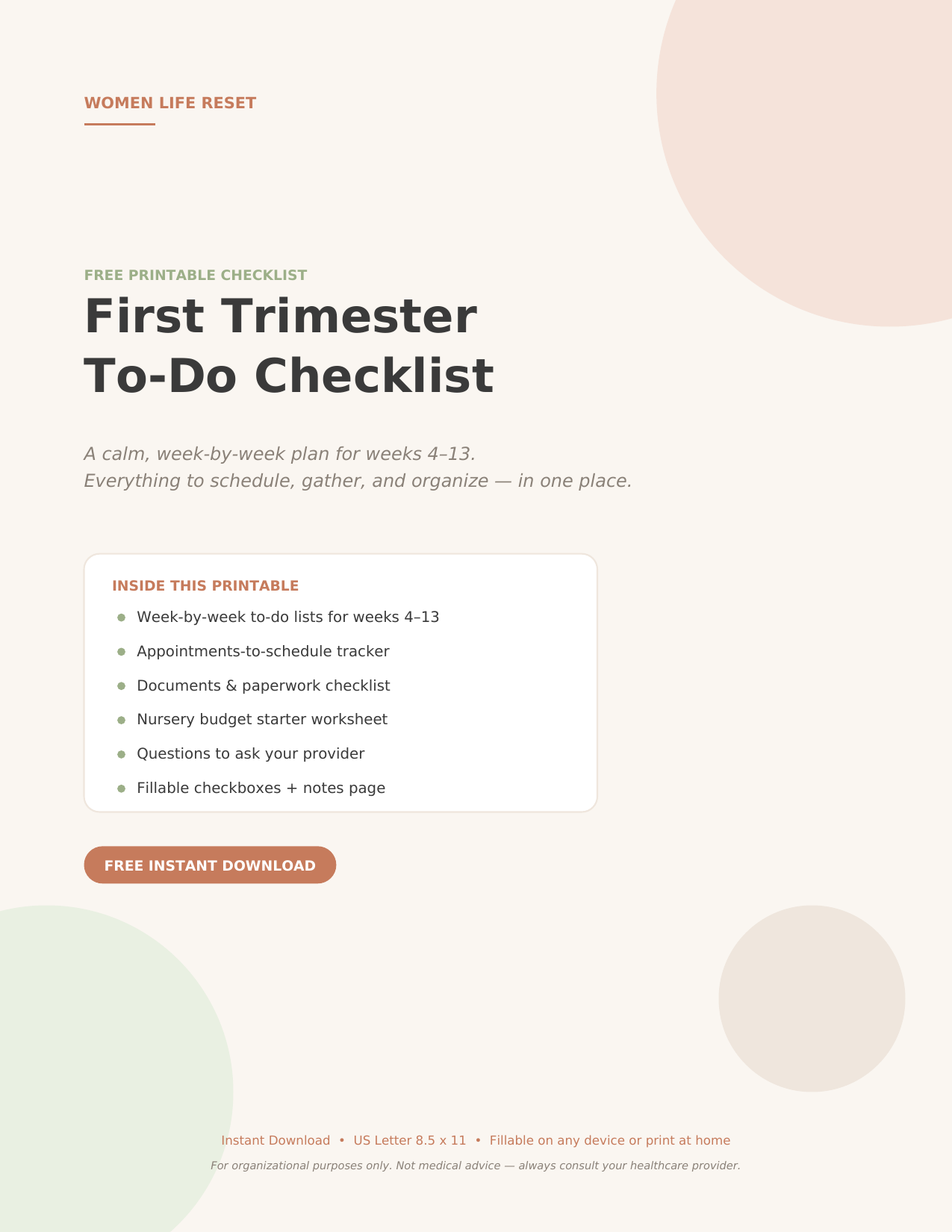
Free: the First Trimester Checklist
Weeks 1–13, gathered on four calm fillable pages — week-by-week to-dos, an appointment log, and room for your notes. It’s free.
6. Let the Shower Do Some Heavy Lifting
Timing is a budget strategy. If a shower is happening, register for the boring-expensive things — the monitor, the sound machine, the storage baskets, the sheets — and keep your own cash for the items you’ll want to choose personally. A registry and a nursery budget are the same list wearing two hats. Build them together and nothing gets bought twice.
7. Storage That Isn’t “Nursery Storage”
Cube shelves, baskets, and drawer dividers are where budget nurseries quietly win. A $40 cube shelf with $6 baskets holds diapers, clothes, blankets, and the mysterious category of “tiny things,” and it looks clean because everything has a door. Repurpose ruthlessly: the over-door shoe organizer becomes a diaper-and-cream station; the kitchen cart becomes a feeding-supply trolley that rolls to wherever the baby actually is. (For the layout logic — where the sleep, change, and feed zones should live so all this storage makes sense — our nursery planning 101 guide maps it out.)
8. Buy the Minimum Wardrobe, Wash on Repeat
Clothes are the sneakiest nursery-budget leak because they’re $12 at a time. The minimalist math: 6–8 onesies and 4–6 sleepers per size, washed twice a week, is a complete newborn wardrobe. Every outfit beyond that is a gift someone will give you anyway. Set a hard cap — say, $100 — and spend the joy-money on one perfect outfit instead of ten okay ones.
9. The Two-Week Rule for Wants
Anything decor-ish that isn’t on the list waits two weeks. Screenshot it, close the tab, and if you still want it in fourteen days, find it secondhand or wait for a sale. Roughly 70% of nursery wants fail the two-week test — that’s not restraint, that’s just what happens when the 1 a.m. feeding-scrolling fog lifts. The 30% that survive are the pieces you’ll love for years.
10. Leave 15% for the “Oh Right” List
Every nursery budget has a second, secret list: the outlet covers, the blackout curtain rod, the extra sheet set, the dimmable bulb for the 3 a.m. feed. Reserve 15% of your total for these from day one, and the last month before baby stops being a drip-feed of small, stressful charges. Future-you, assembling a crib at 36 weeks, will find the missing screw money already waiting.
A Sample $800 Breakdown
| Bucket | Budget | How |
|---|---|---|
| Crib + mattress (new) | $300 | Mid-range new, current standards |
| Dresser/changing (used + topper) | $120 | Resale app + $35 topper |
| Chair/ottoman | $100 | Secondhand armchair + ottoman |
| Paint + supplies | $60 | One gallon, accent wall |
| Storage (shelf + baskets) | $70 | Cube shelf, thrifted baskets |
| Decor + art | $30 | Printables, book pages, thrift mirror |
| Contingency “oh right” fund | $120 | 15% reserve |
| Total | $800 | Room done, savings intact |
The Real Luxury in the Room
Step back at the end and notice what the expensive photo actually gave you: a feeling. Calm, warmth, a room that says someone is loved here. None of that has a price tag — it comes from a lamp on a dimmer, a chair in the corner, books on a shelf, and a parent who isn’t quietly stressing about the credit card bill. That version of the nursery is completely within budget.
Want It All in One Place?
All 25 pages — trimester checklists, weekly planner & newborn trackers — in one bundle. Save nearly half vs. buying separately.
Keep Every Room This Calm
The Baby Registry Checklist sorts 150+ items by room, marks must-haves from skips, and adds up the budget as you tick. Instant download.
This article is for organizational purposes only and isn’t medical advice — your healthcare provider knows your situation best.
These planners and trackers are organizational tools only and are not medical advice. Always consult your healthcare provider about your pregnancy and your baby’s care.
Quick answers
How much does a nursery cost?
Anywhere from $300 to $5,000+. A calm, beautiful nursery is very achievable under $800: crib and mattress new (safety), dresser and decor secondhand, paint doing the heavy lifting.
What nursery items should I buy new?
Crib (post-2011 safety standards) and crib mattress. Everything else — dressers, gliders, decor, storage — is safe and smart secondhand with a quick recall check.
What makes a nursery look expensive?
Restraint: one calm wall color, matching storage baskets, warm light instead of overhead, and negative space. Styled shelves beat stuffed shelves at any budget.
Which nursery items are safe to buy second-hand?
Cots (with a new mattress), dressers, rocking chairs, clothes, toys and decor are all fine used — check for recalls and working hardware. The savings are enormous on items babies use for months, not years.
What should I never buy second-hand?
Car seats (you can’t verify their crash history), mattresses (hygiene and firmness matter), and anything recalled or with missing safety parts. Breast pumps unless designed for multiple users. Everything else is fair game — clean it, check it, enjoy the savings.
Educational only — not medical advice. Always consult your healthcare provider.
One calm email a week
Gentle, practical organization for pregnancy and new motherhood — start with the free First Trimester Checklist (instant download, no account needed).
Free instant download · Opens right in your browser · No Canva account needed
Subscriber perk: private coupon codes by email — our list never pays full price
Make this week easier
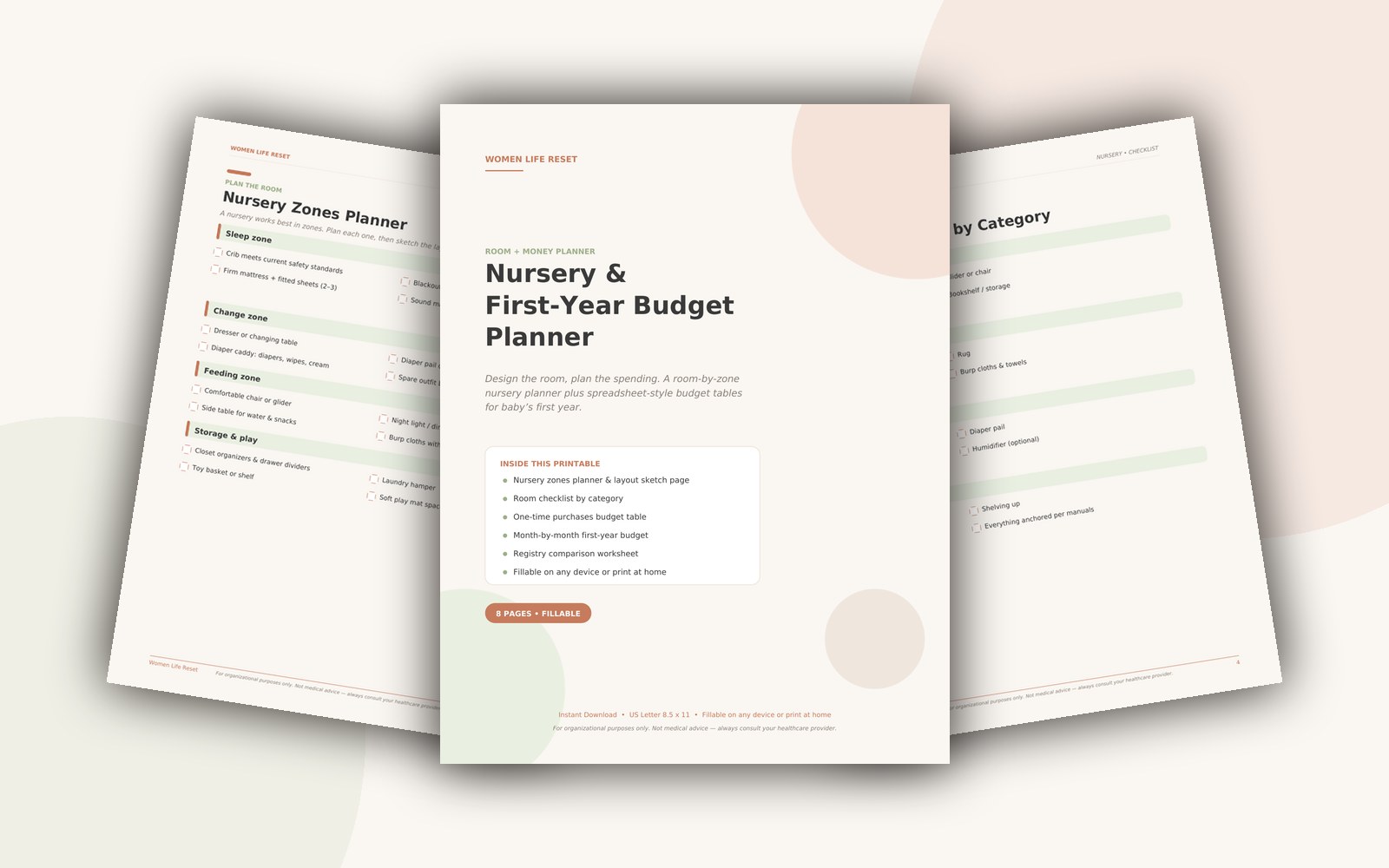 Nursery & Budget Planner$12 See it →
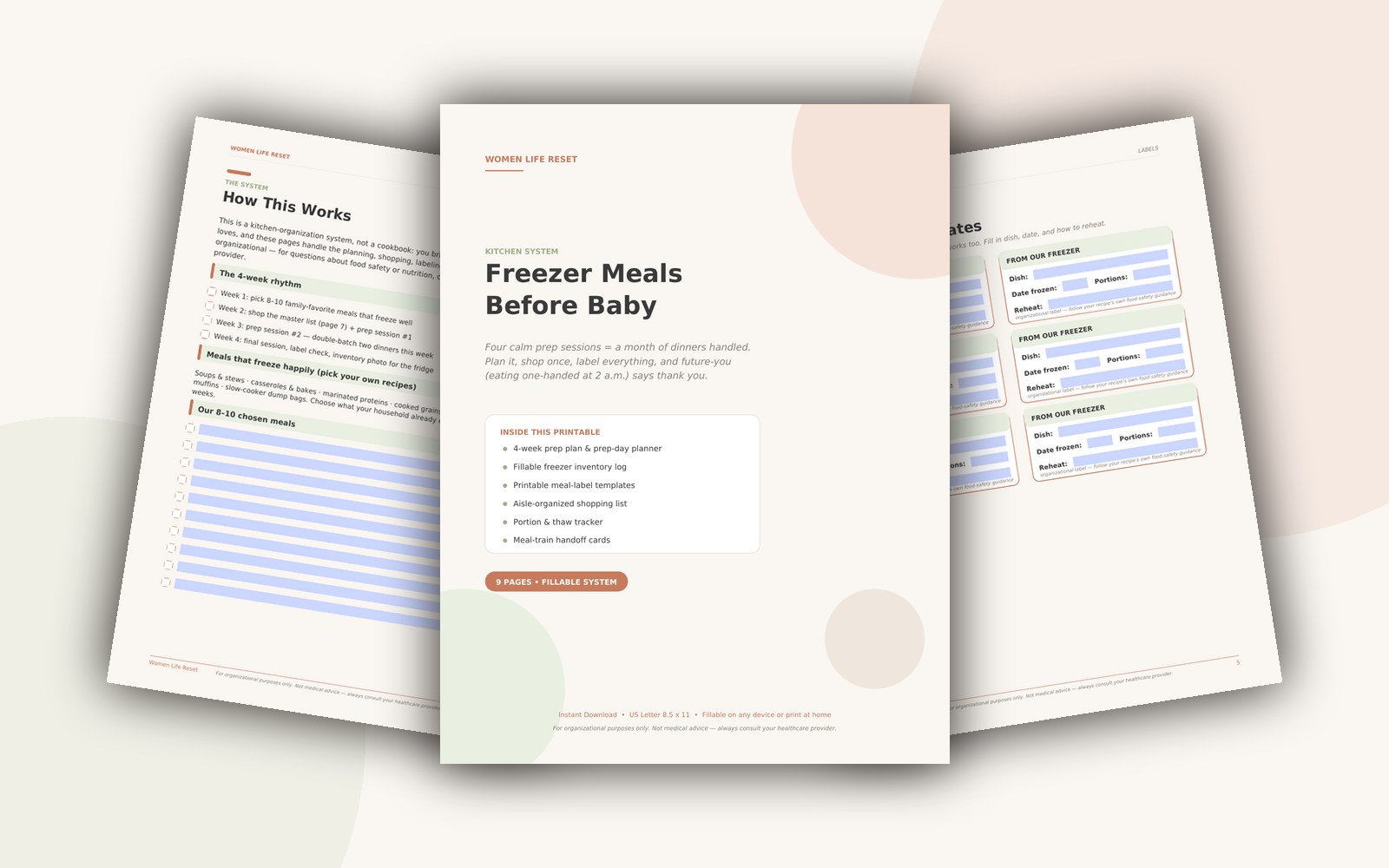 Freezer Meals Before Baby$14 See it →
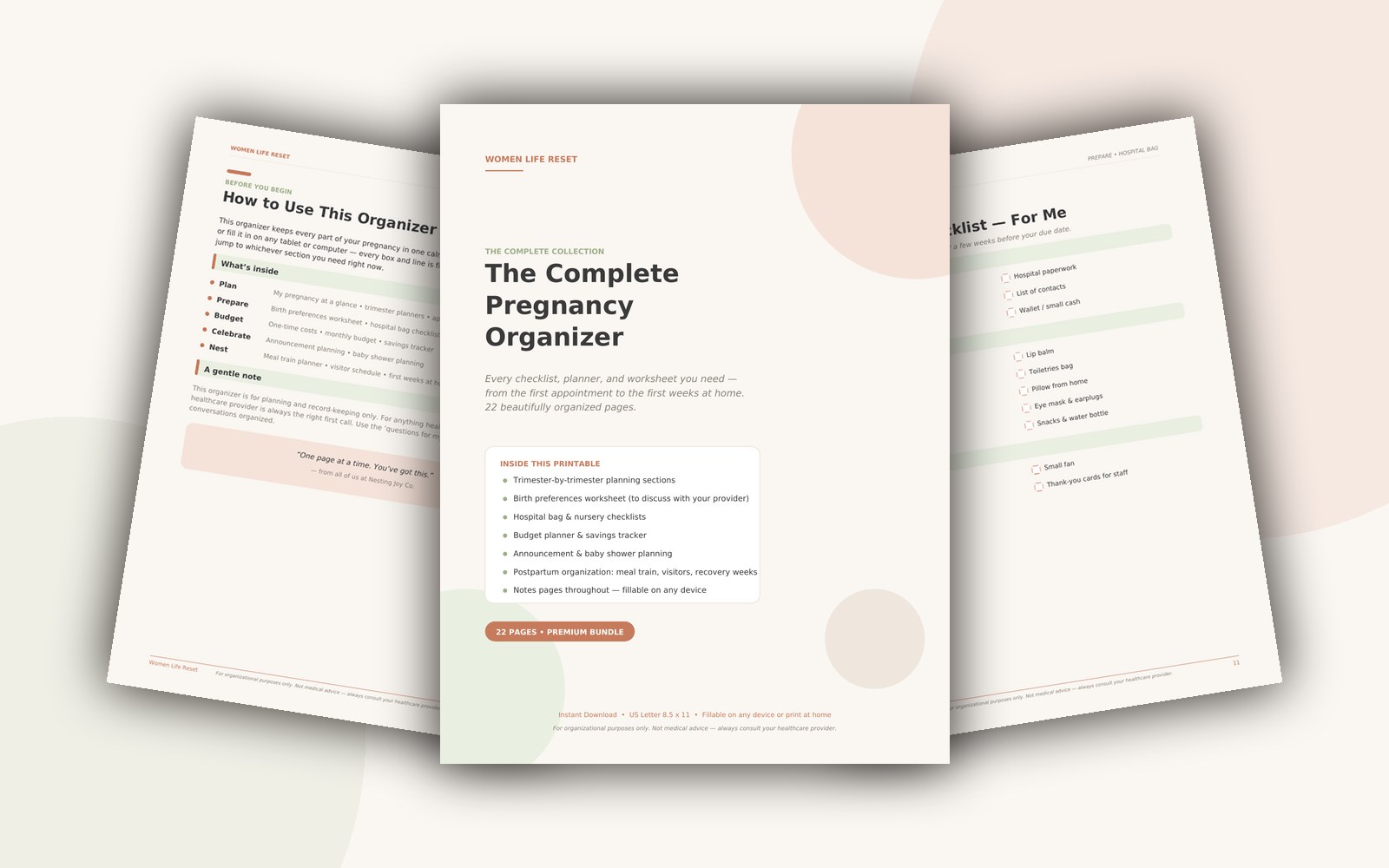 Complete Pregnancy Organizer$34 See it →
I was terrified of labour. The breathing sections changed everything — I walked in actually feeling ready. My midwife asked where I learned it.
Popular on the blog
Fresh from the blog

Your 15% welcome code is waiting
Join the Mom Club and I’ll send you my First Trimester Checklist free, plus your standing code MOMCLUB15 — 15% off everything in the store, every time you shop. One gentle, practical email a week. That’s the whole deal.
No spam, no pressure — unsubscribe anytime and keep the checklist. Only gentle notes from me, Sarah.